'Don't just look at the amount'... 10 years of the Improper Solicitation and Graft Act, and the 'this' that is more important than holiday gift limits
The Improper Solicitation and Graft Act has marked its 10th anniversary, evolving into a standard for fairness in society.
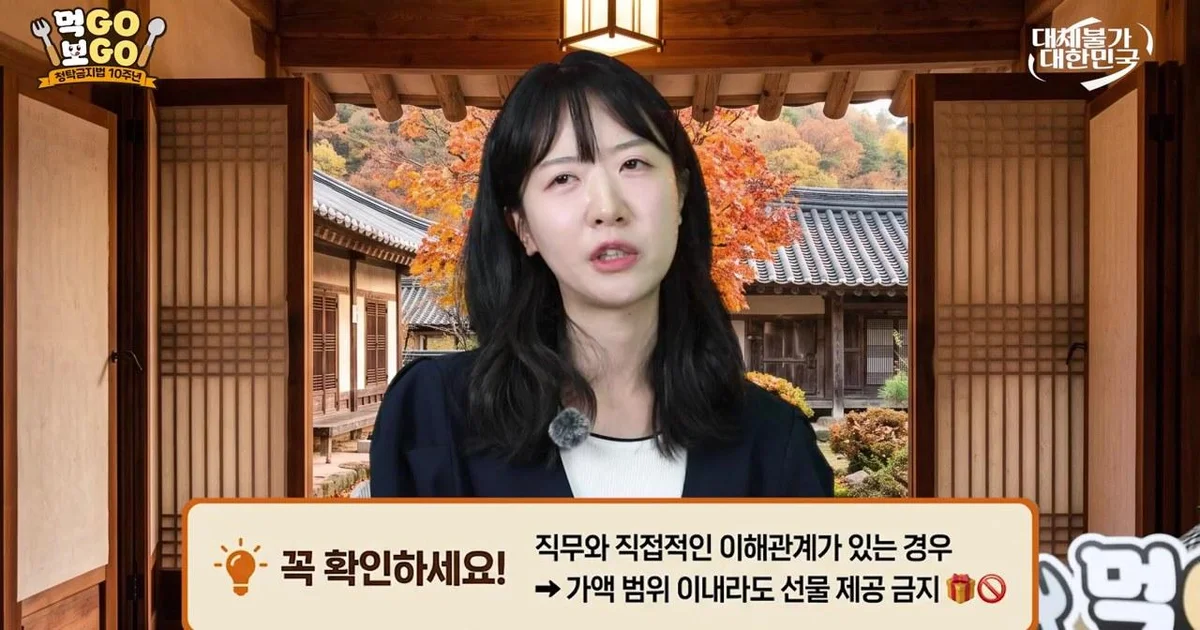
The Improper Solicitation and Graft Act has marked its 10th anniversary since its implementation. Since its first enforcement on September 28, 2016, it is evaluated to have established itself as a core standard supporting fairness in our society. According to the 'Eat GO, See GO' video on the Anti-Corruption and Civil Rights Commission's 'Civil Rights Vision' YouTube channel, the number of reports has decreased noticeably compared to the early stages of the law's enforcement, showing that the system has settled stably.
Report numbers plummet by over 70%... 10 years of becoming a standard in daily life
The Improper Solicitation and Graft Act aims to create a fair and transparent public service society by prohibiting improper solicitation and the receipt of money or valuables by public officials, etc. The scope of application includes 'public officials, etc.,' such as civil servants, executives and employees of public institutions, school faculty and staff, and executives and employees of media companies; citizens can also be subject to the law regarding improper solicitation or the provision of money or valuables. However, the specific scope of application must be carefully checked against relevant laws and regulations.
Statistics from the past 10 years show the settlement process of the system. According to data in the video, the number of annual reports, which reached 4,386 cases in 2018, has significantly decreased to 1,280 cases last year in 2025. This is a decrease of more than approximately 70%. This suggests that past practices have now changed into a standard in daily life that must be 'checked.'
However, there is an analysis that the decrease in report numbers does not necessarily mean the complete settlement of the system. While noting positive signals such as the decrease in report numbers and the number of sanctioned individuals, the video identified challenges to be solved in the future: the fact that the average number of sanctioned individuals remains at the level of 330 people, the increasing proportion of money and valuables receipt, and the increase in the number of people facing criminal punishment. The explanation is that the system should not be concluded to be completely settled solely based on the downward trend of report numbers and sanctioned individuals.
"Holiday gifts up to 300,000 won?"... 'Job relevance' is key rather than the amount
The most confusing part ahead of the Chuseok holiday is the range of gift values. According to the Anti-Corruption and Civil Rights Commission, gifts that can generally be given to a public official related to their duties are limited to 50,000 won. In the case of agricultural, livestock, and fishery products and their processed goods, up to 150,000 won is permitted.
In particular, during holiday periods, the value range is temporarily increased to support farmers and fishermen. During the Seollal and Chuseok holiday periods, the value of gifts for agricultural, livestock, fishery products and their processed goods is permitted up to 300,000 won. However, this is not unconditionally possible in all cases.
The most important criterion is 'job relevance.' In cases where there is a direct interest, such as a member of a permit/license application committee and the official in charge, no gifts can be exchanged at all, even if they are within the value range. In other words, rather than just looking at the value (amount) of the gift, one must comprehensively examine the relationship and situation between the giver and the receiver. The video explained that just as 'hobakjeon' (pumpkin pancakes) requires careful thickness and heat control despite looking simple, one must carefully examine who is doing what to whom and in what situation, even if it looks fine on the surface. It was also mentioned that, like 'sanjeok' (skewers) where various ingredients blend together, one must examine the relationship and situation between people together.
The importance of 'fair rules' to prevent improper solicitation
'Improper solicitation,' another pillar of the Improper Solicitation and Graft Act, refers to acts that interfere with the fair performance of duties by making requests that violate laws or deviate from the possibility of normal transactions when performing duties prescribed by laws and regulations. A representative example is a request such as "do it for me first because we are acquaintances." Like not breaking the rules in Yutnori to move one extra space just because you are close, it is a rule that must be followed for the fair performance of duties.
The Anti-Corruption and Civil Rights Commission stated that the cumulative number of sanctioned individuals since the enforcement of the law has reached a total of 2,983 people. This is based on the latest confirmed data announced by the Anti-Corruption and Civil Rights Commission. Among them, the majority accounted for 2,828 people sanctioned for receiving money or valuables, while improper solicitation was tallied at 140 people, and receiving excessive lecture fees was 15 people. This shows that violations related to the receipt of money and valuables remain the major targets of sanctions.
The video concluded by summarizing three key points. First, just as you must open the filling of a songpyeon to know what is inside, examine the relationship and situation. Second, check not only the amount but also the value and the relationship for gifts. Third, perform duties fairly without improper solicitation, like the rules of Yutnori. The message conveyed was that over the past 10 years, the Improper Solicitation and Graft Act has been a standard for maintaining fairness and transparency in our daily lives, and it is expected to continue to be a reliable standard alongside the people.

Comments 0