6,000 units announced for groundbreaking, but only 498 households are actually under construction... The mismatch of 'Happy Housing'
The government's 'Happy Housing' policy, intended to provide affordable rental housing using idle urban land…
The 'Happy Housing' policy, introduced by the government to stabilize housing for low-income citizens, is facing serious difficulties on the ground, contrary to original plans. While the intention was to supply affordable rental housing by utilizing idle land such as retention basins or railway sites within urban areas, questions are being raised about the effectiveness of the policy as it leads to surging construction costs, resident opposition, and a reduction in the scale of projects.
Unexpected surge in construction costs renders 'affordable supply' intent meaningless
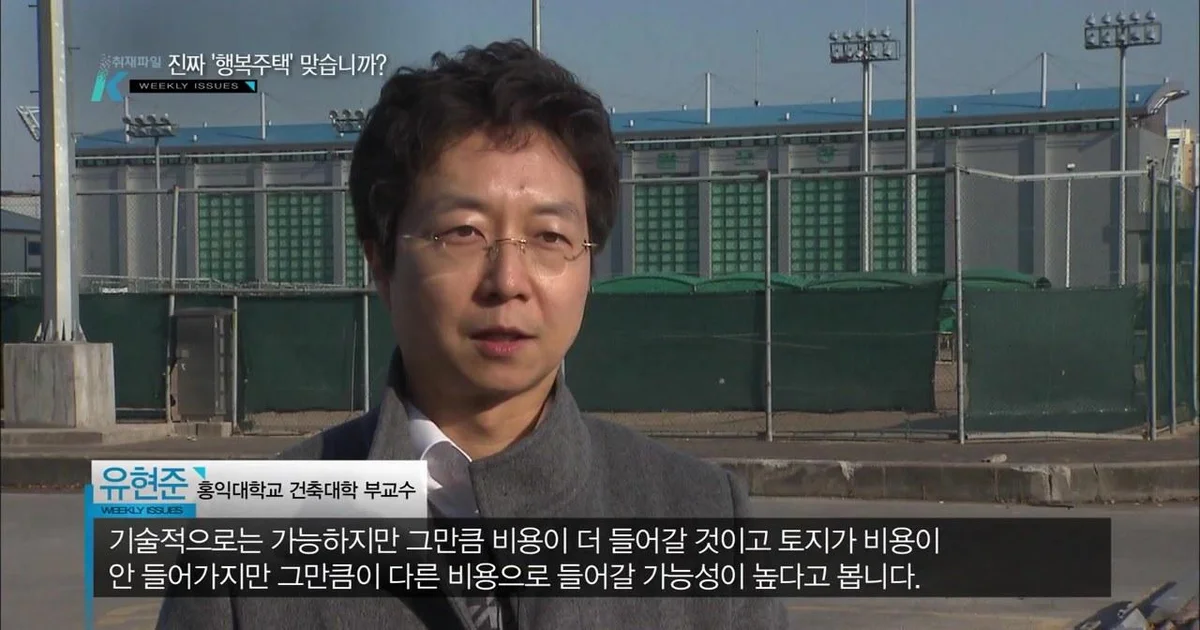
One of the biggest obstacles to the Happy Housing project is the construction cost, which far exceeds original expectations. The government announced it would build Happy Housing for university students and others by utilizing idle land near railway sites, but on the ground, the rise in costs due to technical limitations is being pointed out as a problem. According to a KBS Documentary video, it is essential to install special facilities and artificial decks to build structures on railway sites. The Ministry of Land, Infrastructure and Transport originally expected the construction cost per pyeong to be around 7.5 million to 9 million won, but it is now projected to exceed at least 11 million won.
The situation is even more serious for districts utilizing retention basins (places that temporarily collect rainwater, etc.). Regarding the plan to build up to 1,300 households on retention basins in areas such as Mok-dong, the local government predicted that the construction cost per pyeong would exceed 30 million won if the costs for retention basin safety facilities were included. This figure is double the amount predicted by the Korea Land and Housing Corporation. Experts point out that when building on special sites like railway sites or retention basins, the project's feasibility is low because special construction methods to meet seismic standards and future maintenance costs will be enormous. Ultimately, there are concerns that the increased construction costs will lead to deficits for the Korea Land and Housing Corporation or be passed on as a tax burden.
Pilot districts halted due to lack of resident agreement and safety concerns
Conflicts during the site selection process are also a major cause hindering the project. In some pilot districts such as Gongneung-dong, lawsuits have been filed against the Ministry of Land, Infrastructure and Transport on the grounds that there was no prior agreement with residents. The Ministry of Land, Infrastructure and Transport explained that they reached an agreement on the condition of building resident cultural centers, but confusion arose as the local government refuted the government's announcement, stating that no formal agreement existed.
Anxiety regarding safety issues is also high. Residents are raising concerns that if large-scale apartments are built in retention basin areas where flooding has frequently occurred in the past, surrounding areas could become more vulnerable to floods. For these reasons, the Jamsil and Songpa districts have had their projects suspended, and in the case of Ansan, the direction of the project was shifted to utilize part of reconstructed households instead of the originally planned site. Of the seven pilot districts selected by the government, five have not yet even begun implementation.
Actual construction status differs from the '6,000 units groundbreaking' announcement
A gap has also been revealed between the government's announcement and the actual situation on the ground. The government previously announced that it approved 26,000 units of Happy Housing last year and that 6,000 of them had commenced construction. However, the total number of households where construction is actually underway was only 498, including Samjeon, Seoul, Regok, and the Gajwa District. The government maintained the position that it was not a false announcement, explaining that the expression 'groundbreaking' meant 'selection of the developer' rather than the start of construction.
Ultimately, as the difficulties of the project continued, the government announced a significant reduction of its original goal of constructing 200,000 units to 140,000 units. As the plan to utilize idle land in urban areas hit limits due to construction costs and site issues, the policy direction is being modified, such as expanding the scope of the project to provincial areas. To achieve the original purpose of providing affordable homes for young adults entering society, a fundamental re-examination of realistic construction cost management and the appropriateness of site selection seems necessary.

Comments 0