"I thought he was selfish..." A husband's 'autism spectrum' realized after 20 years
A woman who struggled with her husband's perceived selfishness for 20 years discovered that his behavior was actually due to his autism spectrum.
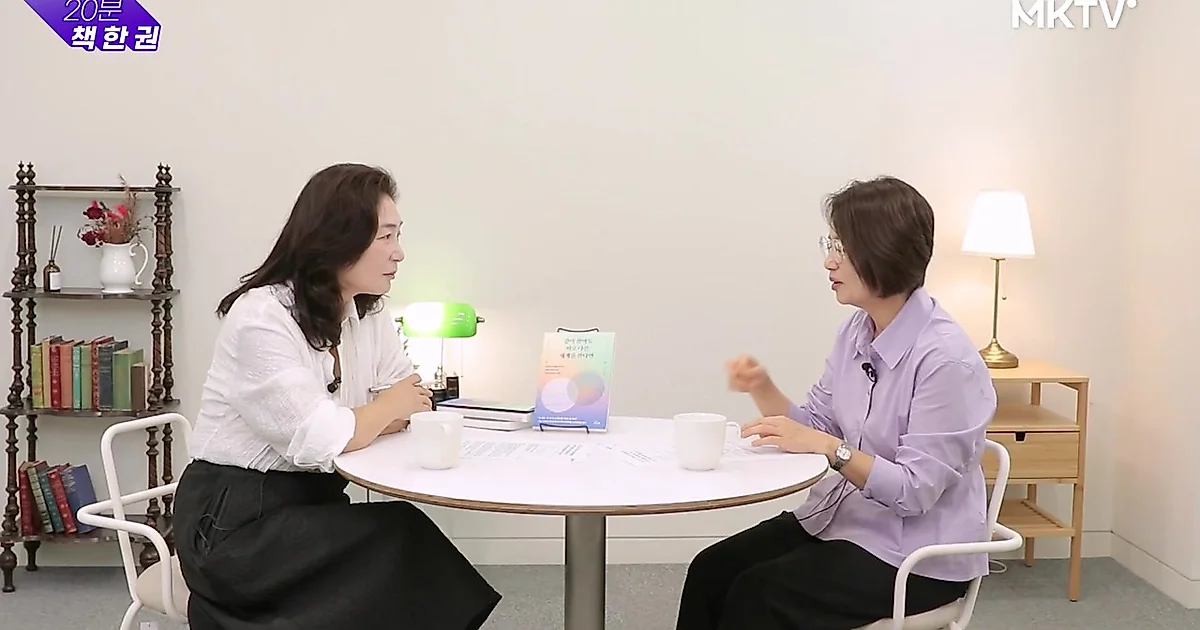
There was a woman who contemplated divorce due to her spouse's indifference and selfish attitude during 20 years of marriage. Her husband was an elite professor who graduated from a gifted school, but within the home, the walls were so high that communication was impossible. His behavior, such as finishing his food in just one minute during a meal and leaving the seat, or flatly refusing his spouse's requests, left deep wounds on the other person. However, the truth revealed after 20 years was not his personality, but that his brain nerves were different from those of ordinary people.
Isolation hidden behind social success, 'Cassandra syndrome'
Writer Ji Eun-jeong, appearing on the MKTV KIM MIKYUNG TV video, explains the pain she experienced before understanding her husband's behavior using the concept of 'Cassandra syndrome.' Cassandra syndrome refers to a phenomenon where a spouse feels isolated alone due to the communication breakdown and indifference of their partner. In particular, when a spouse appears very socially successful or perfect on the outside, the other spouse suffers internally without being able to inform those around them of their pain. It is characterized by being isolated alone because they cannot speak to the outside world while suffering due to a spouse who seems to have no problems on the outside.
Ji says that because her husband was a professor whose outstanding abilities were recognized on the outside, it was even more difficult to reveal the lack of communication experienced inside the house. The fact that his behavior stemmed from the characteristics of 'autism spectrum' rather than simple selfishness was a conclusion reached after searching for related papers and having conversations with her husband as if conducting research. At first, the husband searched extensively for opposing data to refute such claims, but eventually, as he delved deeper, he came to admit that all the information pointed toward himself.
'Sensory hypersensitivity' where all sounds are heard at the same volume
Those with autism spectrum may perceive sensations differently from ordinary people. The video explains this in connection with 'sensory hypersensitivity.' A person with autism spectrum may experience background noise, subtle mechanical sounds, the sound of a person walking next to them, or the sound of a chair being dragged as being heard at the same volume, unlike ordinary people. This becomes a cause of extreme fatigue in daily life.
Ji gave the example of her husband's behavior of going into the study and closing the door when the vacuum cleaner made a sound. In the past, she thought it was simply an act of avoidance or selfishness, but she came to understand that for her husband, in a situation where all background noises are heard at the same volume, the sound of the vacuum cleaner could have come across as unbearably intense. Additionally, the anecdote where the husband passed by a Christmas tree right in front of him without seeing it shows the characteristic of autism spectrum where the surrounding environment may not be perceived when immersed in one's own world. When the husband was inside his own world, the outside world was not clearly visible, to the point where he could repeatedly go in and out of the study without noticing a large tree in the house.
Why 'explicit communication method' is needed instead of implicit expectations
The method of communication was also fundamentally different. While general communication is centered around language, those with autism spectrum tend to see the world through images or patterns. Ji mentioned that demanding "Speak up" to her husband could actually feel like an attack to him. This is because even though an image is drawn in his head, the process of converting it into language is difficult. Since the husband is basically a person for whom speech is not the primary language, even attempts to solve problems through communication can come across as frustrating.
To solve this, the method Ji Eun-jeong is practicing is the 'explicit communication method.' This means abandoning 'implicit expectations' that the other person will just do it, and delivering the desired action in specific sentences. The husband cannot accept the implicit expectation of "he will do it," but he can remember and perform specific instructions in his head. For example, it is a method of clearly informing the situation and action instructions, such as "Please take the trash bag placed in front of the entrance and take it out to throw it away when you go out." This change became a practical tool for connecting their worlds by understanding the characteristics of her spouse, which was not 'not doing it' but 'not being able to do it.'
The 'rolled omelet incident' that occurred during a meal also shows this difference. The husband eating the rolled omelet deliciously without considering his spouse and eating almost all of it, or leaving just one at the end, caused great disappointment and tears for his spouse. However, by understanding that these behaviors were also connected to the absence of empathy or consideration for whether the other person would be hurt—namely, the characteristics of autism spectrum—they were able to seek a change in the relationship.

하비이슈에서 건강·과학 분야를 주로 취재합니다. 테크·미래, 문화·라이프 기사도 함께 씁니다.

Comments 0