"There is no criminal look" — Director Pyo Chang-won explains how to read human nature
Director Pyo Chang-won explains that human nature is revealed through consistent patterns of choice rather than physical appearance or isolated incidents.
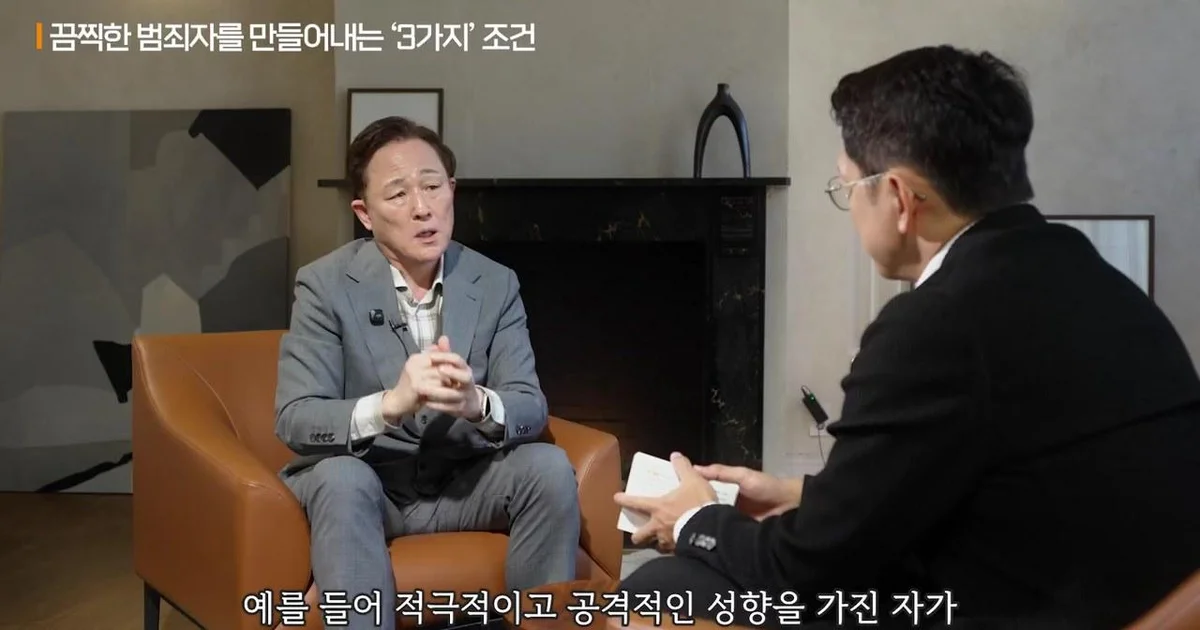
When is human nature revealed? It is often said to be "when they are being kind to you" or "when a problem arises." However, the perspective of a profiler is slightly different. According to a Jisik Inside video, Director Pyo Chang-won points out that it is dangerous to conclude that one side is correct. He explains that the core lies in identifying a person's "tendency of choice"—not a fragmentary appearance in a specific situation, but what kind of choices that person makes at every moment.
Director Pyo emphasizes that the most important point in looking at a person is whether it is possible to objectify "what kind of choices a person makes at every moment, and whether that person is someone who chooses what is right over what is profitable." He warns that one should not mistakenly believe someone is a good person just because they are kind to you. This is because they might be acting kindly because it is beneficial to you. Conversely, if someone tends to choose what is right rather than what is profitable, even if they say unpleasant things to you, they are highly likely to be a trustworthy person.
The illusion of a 'criminal look' and misunderstandings about genetic factors
When a heinous crime occurs, the public often mentions physical characteristics, saying, "They have the look of a criminal from their eyes alone." However, Director Pyo Chang-won warns that such impressionistic criticism may be nothing more than "hindsight bias." His logic is that if a unique impression or gaze for criminals existed, numerous crimes would have already been prevented in advance. He points out that even though criminals live in studio apartments in Seoul, use restaurants, and mingle with neighbors, no one felt their coldness or gloominess.
Citing the case of the notorious American criminal O. J. Simpson, he emphasized that the appearance of a person when facing criminal charges can be vastly different from their appearance when living as an ordinary citizen. He noted that while the photos of him during the criminal investigation featured on the covers of TIME and Newsweek made him look like a criminal to anyone, his appearance during his time as a Hollywood star was entirely different. He analyzed that media reporting that caters to such public psychology reinforces the prejudice of a "criminal look."
Past attempts to find the cause of crime in genetics are also mentioned. Cesare Lombroso, called the father of criminology in the 19th century, studied physical characteristics, claiming that criminals were the result of "atavism," a regression in the evolutionary process, but this was later refuted by modern scholars. Lombroso measured the protrusion of cheekbones, asymmetry, and the length of limbs, but these were revealed to be errors during actual verification processes.
Recently, research was released through Nature stating that a specific gene could increase aggression by affecting serotonin secretion. This was because mice with that specific gene damaged showed patterns of attacking their surroundings. However, in actual studies conducted on humans, it is difficult to explain crime through genetic factors alone. This is because it was difficult to find significant differences in both comparing serotonin levels by extracting cerebrospinal fluid from heinous criminals and in twin studies tracking whether criminals resemble their biological parents or adoptive parents more.
The mechanism by which a 'pro-social psychopath' is born
Even if genetic traits exist, they do not necessarily lead to crime. The video introduces the concept of a 'pro-social psychopath' through the case of a famous neuroscientist. While studying the brains of psychopaths, this scholar discovered that he himself possessed psychopathic tendencies lacking in empathy. He noted that the activation of the prefrontal cortex area during brain imaging of psychopaths differs from that of ordinary people, which he confirmed through his own case.
Through conversations with his mother, he confirmed that he had aggressive tendencies in his childhood, such as killing animals or taking friends' toys. However, he became a successful scholar rather than a criminal. The secret lay in "upbringing and environment." The scholar's mother conducted behavioral therapy by strictly controlling her son's aggressive behavior and rewarding him when he engaged in socially desirable behavior. As a result, he achieved social success by learning that not committing crimes was beneficial to himself.
This suggests that even innate aggressive tendencies can grow into talents who contribute to society if supported by proper education and protection. Director Pyo explains, "Even if there are genetic traits, if appropriate upbringing and protection are provided, all children can grow into talents who are helpful to society." He made it clear that crime is not something one is born with, and one should not label someone as a criminal based on genetic factors.
'Prejudice' and 'Objectification' to be wary of when judging others
Then, how should we distinguish dangerous people and understand others? Director Pyo Chang-won says we must be most wary of 'prejudice,' which is judging people based on external factors such as appearance, background, or linguistic characteristics. He stated that because having preconceptions based on physical characteristics or background is quite dangerous, he takes an attitude of unconditionally giving chances.
He cited 'objectification' as the most important criterion when looking at people. He says one must observe the 'tendency' of whether the other person is acting to take advantage of them, or whether they choose the right path even if they incur a loss. Additionally, he advises that the ability to maintain composure without being buried in one's own emotions and to view the situation by stepping away from a self-centered perspective is the foundation for properly understanding others.
In particular, he cautioned against hastily judging the actions of others. He argued that one should not conclude someone is a bad person just because they do not rejoice with you in happy moments, nor should one criticize them for not being able to help when you are in economic difficulty. It is the true way to see a person by recognizing that the other person's situation and circumstances may be different, and by observing the consistent flow of that person's choices rather than a fragmentary reaction in a specific situation.



Comments 0