"You're good at summarizing, but what is your opinion?" Why experts who dig only one well are in danger in the AI era
Author Baek Young-jae explains why traditional specialized expertise is losing value in the age of AI and why becoming a "boundary person" with the ability…
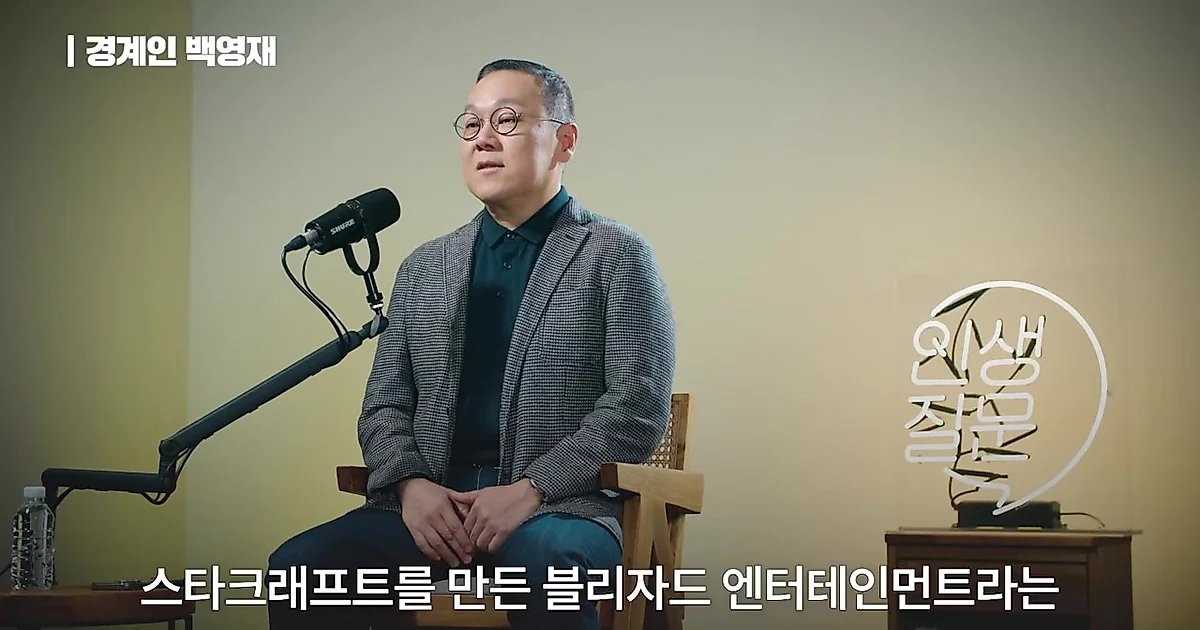
In the past, it was an era where "experts" who accumulated knowledge in a single field for decades and provided correct answers were highly respected. However, the situation changed rapidly with the emergence of artificial intelligence (AI). AI such as ChatGPT, Gemini, and Claude pours out highly professional knowledge in just a few seconds, or even one second. Now, the "digging only one well" type of expertise, a relic of the industrial age, is at risk of its value converging to zero.
According to a Sebasi Talk video, author Baek Young-jae, a businessman who was formerly an anthropologist, defines the career changes in the AI era as an irresistible "mega trend." He predicted, "In the AI era, a single industry will emerge and disappear within 5 to 10 years," and considering that an individual's career span is 30 to 40 years, "a situation will come where you must change industry groups at least four or five times." This suggests that a situation will inevitably arise where individuals must change industry groups to survive, even if they do not wish to.
"The shock of 'Good at summarizing but no opinion' leads to becoming a boundary person"
Baek emphasizes the necessity of a "boundary person" through his own experiences. He was a model student who adapted well to the Korean education system in the past. However, during his studies in the United States, the feedback he received from a professor after submitting an essay changed his life. It was a two-line comment: "Great summary, but what is your opinion?" For him, who was skilled at memorizing correct answers and summarizing information, this was a shock as if being hit on the head with a stone. After obtaining a PhD in anthropology, he hoped for a professorship, but he failed at all 20 universities he applied to. He calls this period his "first year" and spent time in contemplation. He recalls that it took more than a month to recover from this shock, and that the process was a precious time for learning about himself.
Eventually, he turned his eyes toward management consulting by applying anthropological perspectives to business. He judged that what an anthropologist does in the business world is similar to management consulting, and to prove this, he conducted interviews summarized into two pages over three months. As a result, he was able to join McKinsey & Company, and subsequently moved across various industries, serving as the Korean representative for Blizzard Entertainment and working at Philip Morris. He defines a boundary person as "a person who is positioned on the boundary of different cultures or social groups and does not belong completely to any one place." While AI provides answers by probabilistically combining "dead data" that already exists online, a boundary person has the ability to cross into unfamiliar worlds, read the context, and connect different experiences with their own unique perspective. In other words, the "connection ability" to create new questions and perspectives outside of correct answers becomes the true weapon for survival.
The core competency AI cannot imitate, 'MARGIN'
Baek summarized the common core competencies of 33 boundary people he conducted in-depth interviews with into five keywords: 'MARGIN'. The characteristics of people who survive even in the AI era are as follows.
First, M (Metacognition). The ability to objectively look at what one is good at, what one does not know, and what one likes. Second, A (Adaptability). This refers to the ability of 'Unlearning'—discarding past ways of success when entering a new field—and 'Re-learning'—accepting new knowledge. Third, R (Risk-taking). This is not a reckless challenge like in a movie, but the ability to choose a 'manageable risk' that does not cause great damage even if it fails. Fourth, G (Generative Innovation). This is the practice of connecting past experiences with the current field to create new ideas by twisting existing things by about 3%. Finally, N (Novelty Seeking). The fundamental driving force of constantly being curious about and testing new fields.
He mentioned director Heo Myung-haeng of the movie 'The Outlaws' series as a real-life example. Heo, who went from being a stuntman to an action director and then to a ten-million-viewer director, is a person who served as a many times as a stunt double for actor Don Lee. Baek explained that Director Heo possesses excellent metacognition, knowing what he knows and what he must let go of, and is a typical boundary person possessing all five competencies. During the interview process, Director Heo also revealed his inner thoughts, saying, "I don't usually tell others these things, but somehow I end up telling it all today."
Even if you dig only one well, you must know how to 'connect'
Then, must everyone live an unstable life crossing boundaries? Baek says no. People who love a specific field and want to build expertise within it can certainly live that life. However, there is a condition. "Instead of digging only one well, you must become a 'Pi-shaped person' who can dig multiple wells and connect them." This means a structure where the number of wells increases to two, three, and connects horizontally.
He emphasizes that although his own career spanned heterogeneous fields such as anthropology, consulting, and the tobacco industry, there was a clear link at each stage. It is easy to assert that previous experience will not be helpful when moving to a new field, but he says it was a waste to throw away the anthropology he studied for over 10 years, and ultimately that experience became the foundation for new fields. He placed the most important criterion for career choice on "is this something I can do enjoyably." His core message is that as the speed at which AI provides correct answers increases, humans must develop the 'power of connection' to ask unfamiliar questions and link different domains.
Comments 0