'Bonanza' Gold Vein Found in Taebaek Mountains Gold Mine... Two to Three Times Higher Gold Content Than Other Ores
An EBS documentary explores the intense labor and high-grade gold veins found in a gold mine located in the foothills of the Taebaek Mountains.
Gold, the treasure humanity has valued most. The EBS 'Extreme Jobs - Gold Mine Parts 1~2', broadcast from November 11 to 12, 2009, visited people mining gold at a gold mine in the foothills of the Taebaek Mountains. According to the video description, despite high demand and value at the time, domestic gold production was minimal, but fueled by the gold rush, busy work was in full swing at domestic gold mines. The place where they work is a tunnel filled with moisture and dust, 120m below the surface.
A 'Bonanza' with Two to Three Times the Gold Content... Identifying Veins by Smell
The video begins with a scene where a rock worthy of being called a 'bonanza' is discovered. On-site, it was described as the highest-grade gold vein discovered so far, something hard to see even if one lives a lifetime. This gold ore, with gold particles clearly visible on its surface, has a gold content two to three times higher than other ores. Experts can identify gold veins not only by color but also by smell. The explanation is that it smells of sulfur because sulfur minerals like chalcopyrite and pyrite, which contain metals, are included.
Employees conduct vein investigations by hiking around the gold mine whenever they have time. A 'node' refers to a part where the gold vein emerges partially on the surface rather than underground. The gold vein map, created through decades of node investigations in the mountains, is like a treasure map, as it depicts both the thickness and direction of the veins. Mining is also carried out by following the direction of these veins. They do not treat even the rocks frequently kicked by their feet carelessly because they have seen their true nature, harboring gold.
Removing Loose Rocks is Mandatory the Day After Blasting... Stone Fragments Flying Toward Faces
According to the video description, unlike coal mines, gold mines involve descending vertically and then drilling horizontally, which presents more hazards. To enter the tunnels, miners perform blasting operations every day, drilling holes into rock as hard as iron, inserting explosives, and connecting wires by hand one by one. Although it is a routine task, every moment feels like walking on thin ice because a small mistake can lead to immense danger.
The task that must be performed before mining the day after blasting is removing rocks that pose a risk of falling. Because the ground of the walls and ceiling becomes much weaker after blasting, miners tap various parts of the ceiling to find loose rocks. Even if they look fine, many rocks are at risk of falling. Since metallic ore follows the vein, there is a risk of collapse if the ceiling and walls consist of different types of rock. While transporting gold ore blasted the previous day, there was a dizzying moment when a stone fragment flew toward a worker's face and seemed to hit near the eye. It was a great relief that it ended as a minor wound.
Installing rails to move the mined gold is also arduous work. According to the video description, they must bring in welded rails and lay them by hand, with miners struggling against 90kg rails. If the floor is not flat, it is impossible to lay the tracks, so they level the floor by hand one by one, and they try to crush hard rocks hidden in the floor with machines, but even this is not easy.
30g of Fine Powder at 1,200 Degrees... Gold Particles So Small They Could Blow Away
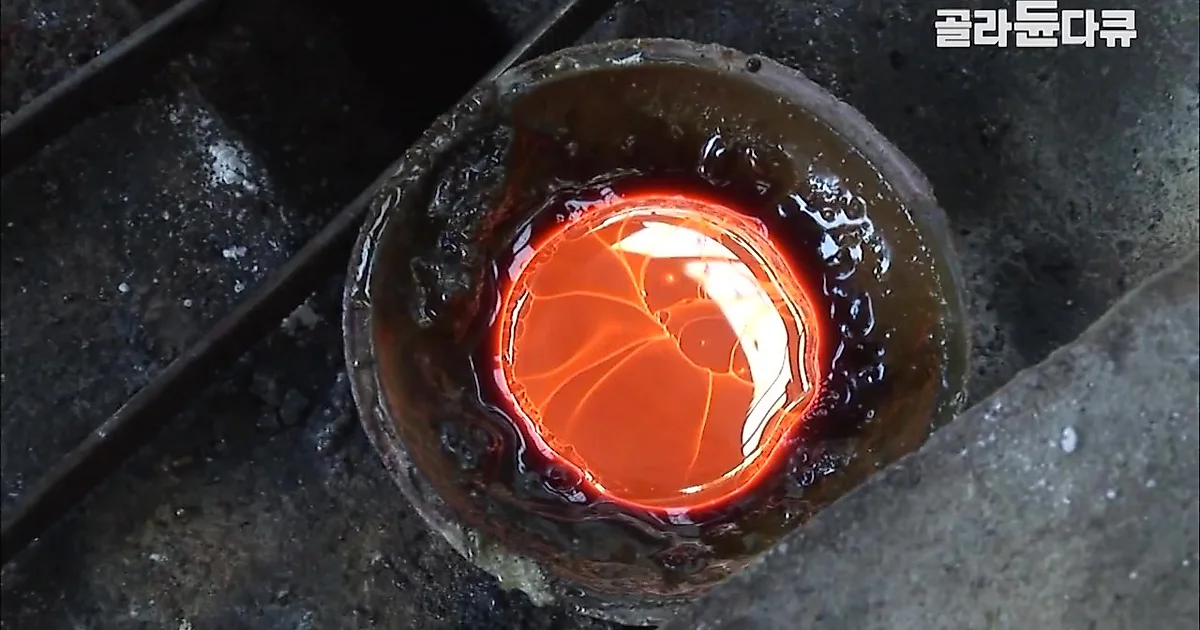
Gold ore blasted each day is sampled and sent to the analysis room. Since the metal content inside the ore is so minute, if the rock particles are too coarse, they cannot melt the inside; therefore, they continue pounding with a mortar until their arms ache to make it into a fine powder, then take exactly 30g for analysis. An oxidation flame plays the role of carrying the gold down, while caustic soda or borax plays the role of creating moisture. After mixing five types of reagents and the gold ore powder into a crucible, the temperature is raised to 1,200 degrees for the gold, which has a higher melting point than other metals.
If only the silver part at the end of the two-layered mass is separated, it becomes a metal mass containing gold, silver, copper, and iron. When this is reheated to vaporize the lead component, an alloy of gold and silver remains, and finally, when nitric acid is added to oxidize only the silver component, tiny gold particles that look like they could blow away appear. When calculated per 1 ton, the amount of gold is about 5g, and the video stated that this is not a bad amount.
Hard as Cast Iron... From Crushing and Beneficiation to Concentrate
Gold ore is as hard as cast iron. The gold ore enters a massive crusher and undergoes several crushing processes; the finer it is broken, the easier it is to extract the gold. Whenever the crusher's inlet gets clogged, one person unblocks it by hand. The finely crushed gold ore goes to the beneficiation plant. When various reagents are added to the gold ore powder, the metallic components adhere to the bubbles and float on the water; this collected metal powder, after removing moisture and saltiness in a machine called a filter press, is called concentrate. High-grade gold concentrate is a powder concentrated to more than 1/100th of the volume of the gold ore, and if viewed closely, dense, sparkling gold particles can be confirmed.
The gold concentrate collected over a month heads straight to the smelter. The video explains that since most of South Korea's gold production involves importing raw ore and smelting it, gold mined directly from domestic gold mines is extremely rare and precious. High-grade concentrate is sometimes smelted directly at the mine, where borax, caustic soda, and even flour are mixed with the concentrate, and a thick layer of salt is laid down to prevent the ore from splashing. While the soil containing gold is melted in a crucible for more than 3 hours, the gold melts starting from 1,000 degrees or more, filling the area around the furnace with intense heat, and there was even a dizzying situation where the mold caught fire due to the oil component of the wax used to coat the mold before pouring the molten gold.
A Job Others Avoid, Another Name for Hope
Some say they are looking for illusory gold, and others point fingers, calling them scammers. However, these are people who have silently dedicated 30 years of their lives to the gold mine. The fact that it is a job everyone else avoids gave them the pride that it is a job that must be done by them. One worker said that since not much gold is produced in South Korea, if a lot comes out of their mine, there would be many benefits and a sense of pride in various ways. To them, gold is another name for hope.

하비이슈에서 문화·라이프 분야를 주로 취재합니다. 사회·이슈, 건강·과학 기사도 함께 씁니다.



Comments 0