"It would have been impossible 5 years ago"... Professor Lee Joon-ho of Seoul National University speaks on the possibility of reverse-aging
Professor Lee Joon-ho of Seoul National University discusses how advancements in technology like AI and gene editing are making reverse-aging a scientific…
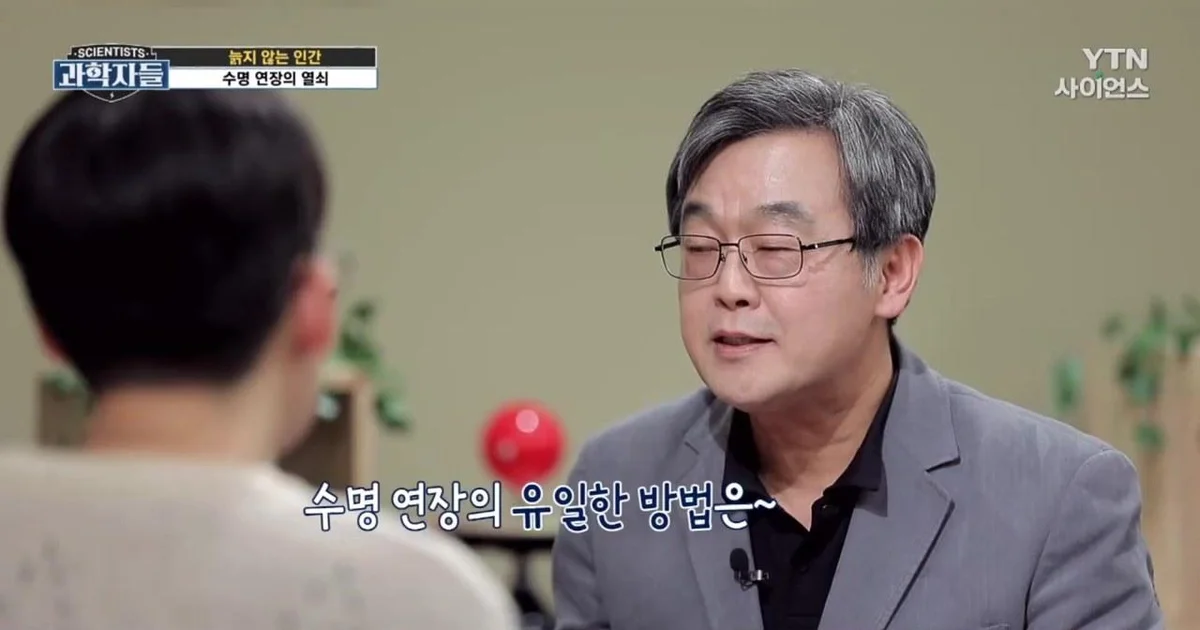
The long-held dream of humanity, 'restoring youth,' may no longer be just a story in movies. Recently, in the life sciences field, research is actively progressing beyond 'Slow-aging,' which simply slows down aging, toward 'Reverse-aging,' which turns already aged cells back into young ones.
"It is not impossible"... The possibility of reverse-aging brought by technological advancement
According to a YTN Science video, Professor Lee Joon-ho of the Department of Biological Sciences at Seoul National University expressed the view that reverse-aging is "not impossible" with current technological capabilities, unlike in the past. This is because the advancement of cutting-edge technologies such as gene scissors and AI is creating changes that exceed human imagination.
Professor Lee explains the concept of aging by dividing it into the organism level and the cellular level. Aging at the cellular level means 'a state where cells no longer divide.' Aging at the organism level means the overall decline in bodily functions, which is closely related to 'healthy lifespan' rather than maximum lifespan. Professor Lee emphasized that research should focus on maintaining a young and healthy state, rather than simply increasing lifespan while being unable to do anything due to conditions like dementia.
In particular, research using the 'Yamanaka factors' discovered by Professor Yamanaka of Japan to turn aged cells into induced pluripotent stem cells (iPS cells) is drawing attention as a core mechanism of reverse-aging that returns cells to a completely young state. However, he added that the practical goal of current research is not to turn cells back into babies, but to turn back the hands of the aged clock to a certain extent to maintain a healthy state.
There are also cases in nature that have overcome the limits of aging. Organisms such as 'Hydra' show that the aging process is reversible, as they continue life by replacing themselves with new cells through stem cells when they grow old and sick, or by regulating genes to return to a baby state. These biological phenomena provide important inspiration for human reverse-aging research.
The key to determining lifespan: 'DNA repair capability' and 'calorie restriction'
Then, why is the lifespan different for each organism? Professor Lee explains that lifespan is not simply a process of cells becoming old, but a biological phenomenon programmed into the genes. The main research model, 'C. elegans,' is only 1mm long, takes only about 3.5 days for a generation to pass, and about 300 individuals are born in one generation, making it an optimized model for genetic research. Unlike the human brain (about 86 billion), this nematode has 302 neurons, making it easy to study the nervous system and lifespan.
In particular, the activity of the 'proofreading function,' which corrects errors occurring during the DNA replication process, becomes an important variable that determines the lifespan of a species. DNA is constantly damaged when exposed to the environment, and while some species repair this damage very strictly and quickly, others pass it off as insignificant. The better an animal is at precisely fixing damage, the relatively longer it can live. In fact, animals with very low mutation rates tend to have long lifespans.
Furthermore, the only method known to be effective in extending the lifespan of all animal species is 'calorie restriction.' Professor Lee mentioned that through C. elegans research, it has been proven that if a mutation occurs in a specific gene, the lifespan can double, emphasizing that aging is regulated by genetic programs. In the plant Arabidopsis, it has also been discovered that a very long life occurs when a specific mutation occurs.
The 'dangerous tightrope' between the protective function of Telomere and cancer occurrence
A keyword that is never omitted in aging research is 'Telomere,' located at the ends of chromosomes. Telomere acts like a 'cap on the end of a shoelace' that protects the blueprint containing genetic information. Every time a cell divides, the length of this Telomere gradually shortens, and if it becomes shorter than a certain level, the cell enters a state of 'cellular senescence' where it no longer divides.
Theoretically, it seems as though lifespan could be extended by activating 'Telomerase,' an enzyme that increases Telomere length again. However, there is a fatal trap here. This is because the shortening of Telomeres to stop cell division is, paradoxically, also a defense mechanism that prevents cells from proliferating infinitely and becoming 'cancer.'
In fact, Telomerase activity is almost non-existent in human somatic cells and is only activated in germ cells or very young cells to play a role in preventing cancer. Professor Lee warned, "It is good to increase the number of divisions by increasing Telomerase activity, but if the mutations accumulated during division cannot be handled together, the probability of cancer occurrence may increase." Ultimately, he explained that true lifespan extension is an area that is possible only when the ability to increase cell division is secured simultaneously with the ability to perfectly repair DNA damage.

Comments 0