"Is Jagyeongnu the Beginning of AI?" Daegu National Science Museum Presents Questions on Coexisting with Artificial Intelligence
The Daegu National Science Museum has opened the 'AI Industrial Technology Hall,' a new space where citizens can experience the evolution of technology…
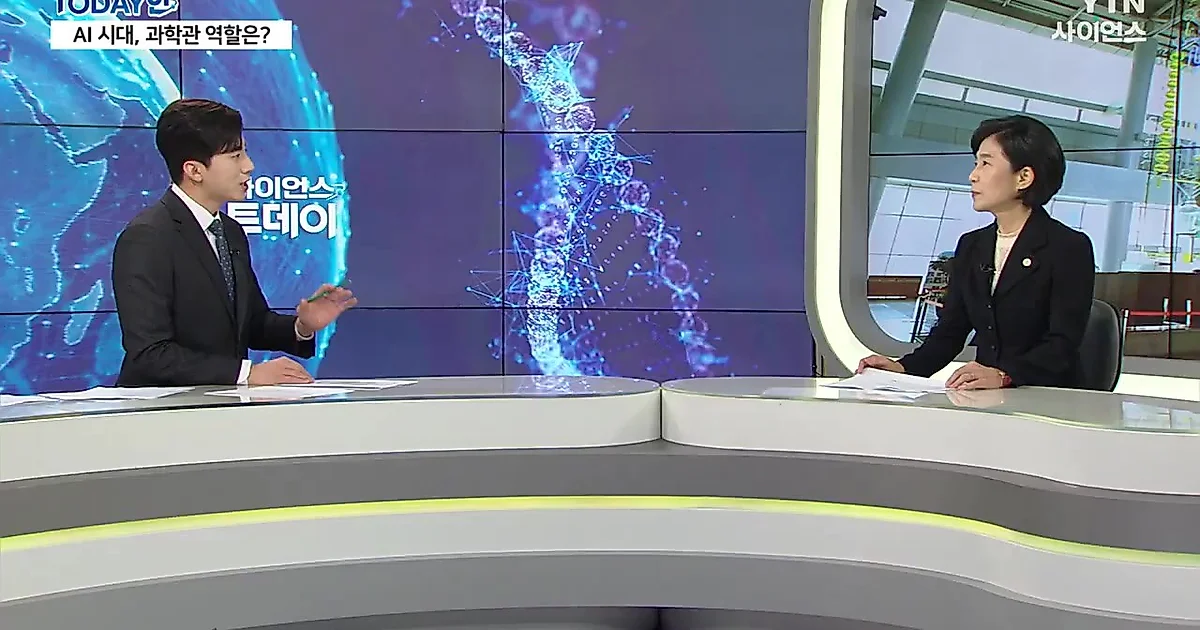
Regarding the question of how artificial intelligence (AI) will change human roles, a space has opened where answers can be found by directly experiencing science and technology. According to a YTN Science video, the Daegu National Science Museum recently opened the new 'AI Industrial Technology Hall' where visitors can experience and understand AI technology. This space is considered the most carefully prepared exhibition this year, serving as a hub science museum for the Daegu and Gyeongbuk regions where citizens can directly experience everything from basic science to advanced technology.
Jagyeongnu Media Art Symbolizing the 'Beginning of Automation'
The newly opened AI Industrial Technology Hall is a permanent exhibition hall where visitors can contemplate the past and present of artificial intelligence, AI industrial sites in our lives, and a future where humans and AI live together. This exhibition brings together the excellent research achievements and industrial technologies of various domestic research institutes, universities, and companies into a single exhibition space. It is designed not merely to show completed technologies, but to become a living space for industry connected to people's lives by allowing citizens to directly see, experience, question, and imagine the development process of science and technology.
The introduction of the exhibition begins with the fundamental question, "What would you ask AI?" This is intended to capture the process of human curiosity, which has continued from the past, evolving into self-thinking artificial intelligence. At the center of the exhibition hall, media art utilizing the traditional scientific heritage 'Jagyeongnu' stands as a core exhibit. Lee Nan-hee, Director of the Daegu National Science Museum, stated in the video that Jagyeongnu was symbolized as the "starting point of automation and AI." This space, designed to let past technology and modern advanced technology intersect, symbolically demonstrates the more accurate analysis, faster judgment, safer environments, and more convenient lives that artificial intelligence will bring.
From Humanoid Robots to Real-time Statistics, Experiencing 'Physical AI'
Visitors can concretely experience invisible AI technology through immersive content. In the experience zone at the latter half of the exhibition hall, humanoid robots that interact with humans and precision robot arms are placed, allowing visitors to witness the dynamic movements of 'Physical AI' that possesses a physical entity right before their eyes. Furthermore, it vividly conveys the current state of our industry by organizing actual AI application cases from excellent research institutes and companies, such as the Korea Institute of Industrial Technology and DGIST (Daegu Gyeongbuk Institute of Science and Technology), in a modular format.
A particularly interesting point is the process where visitor participation is converted into data. In the final participatory space of the exhibition, when visitors press buttons to respond to philosophical questions related to artificial intelligence, those choices appear on a real-time statistics screen. Through this, visitors can compare their own perspectives with those of others and directly reflect on the 'future coexisting with AI' that our society will draw together.
'AI Play School' and Citizen Platforms: A Paradigm Shift in Education
The Daegu National Science Museum defines AI not as the exclusive domain of experts, but as a basic competency that everyone should possess, and operates the 'AI Citizen Platform' for each life cycle under the vision of 'Citizens growing with AI, a city innovating with AI.' In particular, the 'AI Play School' for youth is a representative program designed considering realistic constraints such as age limits for generative AI services. Through cooperation with the Daegu Metropolitan Office of Education, the AI education learned in schools has been newly reorganized into six vocational experience zones, and through the science museum-style AI education model consisting of 'Play-Experience-Inquiry-Creation-Presentation,' it helps children develop the ability to solve problems themselves.
In addition, it performs a hub role encompassing the entire nation through the 'AI Workplace Innovation Academy,' which builds practical capabilities for local public institutions and citizens, and the 'AI Citizen Literacy' project, which visits those lacking educational opportunities. Director Lee expressed her ambition, stating, "Rather than simply teaching how to operate devices, we will ensure that everyone can use AI as a partner to unfold their imagination, rather than fearing it or accepting it passively—that is, as a 'future AI agent.'"
The Daegu National Science Museum intends to transition from a science museum that teaches AI to a science museum that nurtures future talent who solves problems using AI. The final space of the exhibition leaves a deep impression on visitors by posing the question, "How will my question today change the future?" Director Lee defined science as "the most enjoyable tool that makes us imagine tomorrow" and emphasized that they would present a new standard for an 'open, future-oriented advanced science museum' where all generations constantly question and grow together.

하비이슈에서 테크·미래 분야를 주로 취재합니다. 건강·과학 기사도 함께 씁니다.

Comments 0