South Korea's Only Cloud Laboratory Established in Jeju Island, the Key to Artificial Rain is 'Particle Size'
A specialized laboratory at the National Institute of Meteorological Sciences in Jeju Island features South Korea's only 'Cloud Physics Experimental Chamber'…
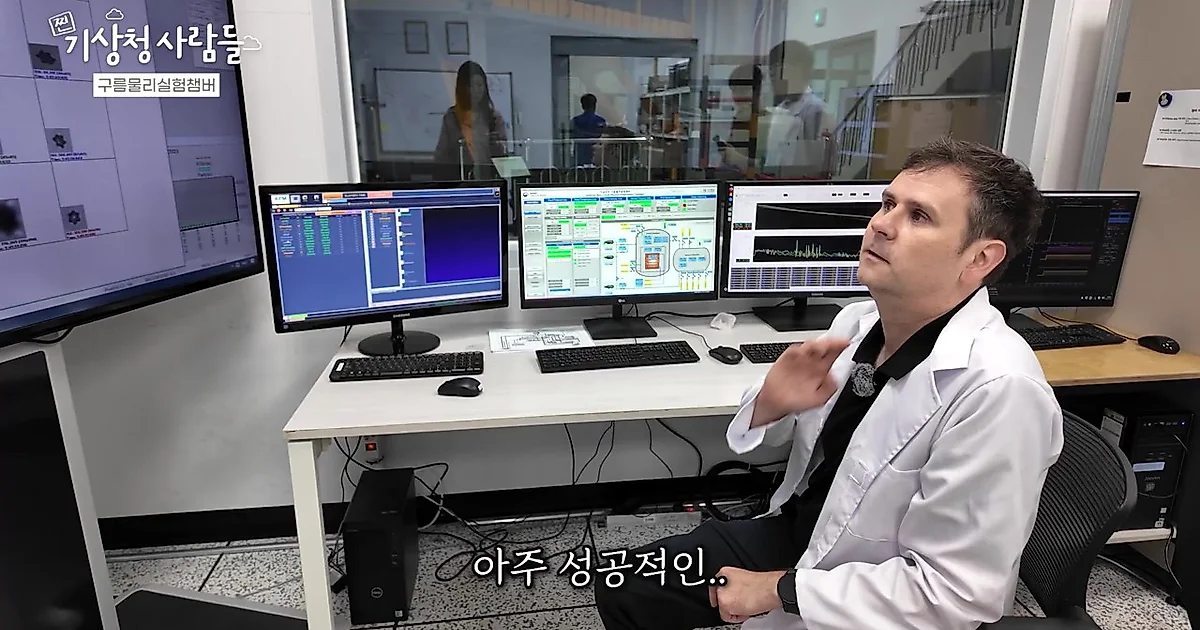
At the National Institute of Meteorological Sciences in Jeju Island, there is a special laboratory where clouds are created directly indoors. According to a video from the Korea Meteorological Administration, this is a laboratory equipped with the nation's only 'Cloud Physics Experimental Chamber,' where clouds can be directly generated and observed. The person leading the research and building the chamber is Dr. Milo from Slovakia. The video introduces everything from the experimental methods for artificial rain—a future meteorological technology for alleviating droughts and reducing fine dust—to the moment of observing ice crystals (snow crystals) blooming inside the chamber.
A 'Cloud Factory' Designed with a Dual Structure
When asked by the production team if it is a factory, Dr. Milo replied that in a way, it could be thought of as a factory. The chamber began its design and construction in 2021, was completed in 2022, and performed its first successful cloud experiment in 2024. Dr. Milo looked back, noting that he has been in charge of everything from the design stage to construction and application, and that it was no ordinary task and was very difficult. It is said that there are fewer than 10 such laboratories in the world.
The chamber has a structure where there is another chamber inside the chamber. The role of the outer chamber is to regulate atmospheric pressure. Because regulation would not work well due to heat if there were only an outer chamber, a small inner chamber was installed separately, and refrigerant is flowed into this small chamber to maintain a uniform environment.
The Key to Artificial Rain Research is Cloud Particle Size
Dr. Milo explained that the overall purpose of the chamber is artificial rain. They test artificial rain seeding materials and research not only artificial rain but also natural phenomena, and the most important factor among them is the size of the cloud particles. If an electric field is created to grow cloud particles, the particles can stick to each other better within it to create large cloud particles, which can lead to precipitation. However, to produce precipitation efficiently, it must be done on a large scale, but since development is not yet advanced, he said that while it is theoretically possible, they are not yet at that stage.
He explained that even now, it is difficult to create precipitation in a state without clouds; clouds must be present. It is a method of seeding clouds that are not raining. Dr. Milo introduced artificial rain as a technology that is developing not only in Korea but globally to allow for more precipitation due to droughts or fine dust.
Ignition of Combustion Pellets and Injection of Aerosol Particles
When performing artificial rain, combustion pellets installed on airplane wings are used. If the particles in the smoke produced as the material inside the combustion pellet burns are injected into the clouds, cloud formation can be further advanced. Dr. Milo said that these days, there is hope in seeding using drones rather than airplanes, and the experiment was conducted to match the drone's speed of 20m per second.
The combustion pellet burns for about 5 minutes and generates particles, at a very high concentration of 40,000 particles per 3cm³. Dr. Milo said he is working to improve the system so that everything can be controlled from one place, but since many parts are not yet automated, there is a lot of work to do while moving back and forth. On this day, equipment that was supposed to be controlled from one place failed to operate, so he had to stop it manually, and he said he would contact the manufacturer as it did not work well even when he tried to fix it.
Dr. Milo monitored the conditions inside the chamber in real time. He explained that particles must be injected into the aerosol chamber to reach a concentration of about 500 for the experiment to proceed successfully. He injected particles by opening the manual valve with his hand to check the concentration, and once it stabilized slightly, he would open it again. He also mentioned that he sometimes comes to the chamber at night because time is insufficient, such as when he cannot finish all the preparations the day before an experiment and has to come out again in the evening to prepare.
Ice Crystals Blooming at -5 Degrees Celsius
When the inside of the chamber was illuminated with a laser, small green dots were seen moving. As the temperature dropped to -5 degrees Celsius, ice crystal particles were gradually observed, and the shape of the particles changes depending on the relative humidity and temperature. Dr. Milo explained that if particles shaped like snowflakes are created, it is a very successful experiment. He added that if natural aerosols are used, the process usually starts working only when the temperature drops to -20 degrees Celsius, but artificial particles create cloud particles much more easily than natural aerosols. He recalled feeling truly moved when the first successful experiment was conducted, and just as everyone applauds when a launch is successful, there was a lot of applause in the laboratory.
Dr. Milo, who has been in Korea for 19 years and has worked at the Korea Meteorological Administration for 10 years, said in the interview, "The cloud chamber is my life." He stated that the cloud chamber is a very large mission and challenge, and while it is not yet complete, he hopes to develop it to a very high global standard and that the cloud laboratory data will be well-utilized elsewhere. His colleague described Dr. Milo as a mentor-like figure from whom there is much to learn.

하비이슈에서 건강·과학 분야를 주로 취재합니다. 테크·미래, 사회·이슈 기사도 함께 씁니다.


Comments 0