Gotjawal, covering 6% of Jeju's area, has twice the carbon storage of mainland Quercus acutissima
The Gotjawal forest in Jeju Island, characterized by its unique volcanic terrain and high tree density…
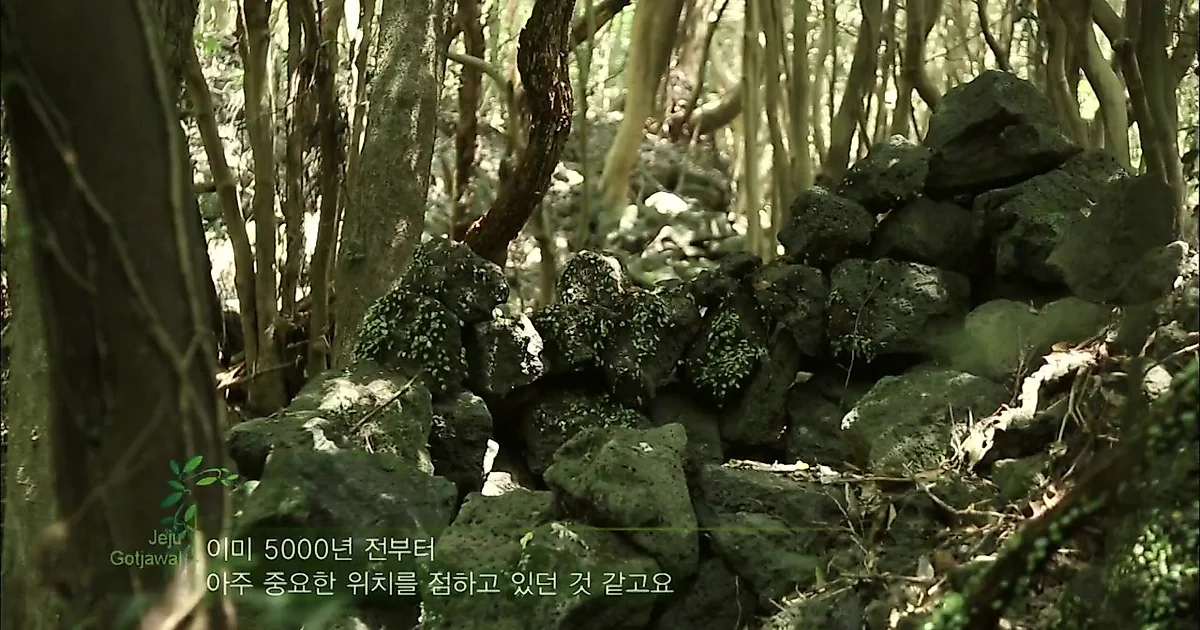
Connecting Hallasan Mountain and the coast, Gotjawal is a forest unique to Jeju Island, spread widely across the mid-mountain areas at altitudes of 200 to 400m above sea level. According to the KBS special 'Forest of Life: Gotjawal, the Lungs of Jeju' broadcast on September 25, 2013, the Gotjawal, which accounts for 6% of the area of Jeju Island, is home to 710 species of plants and over 100 species of animals, including insects and birds. Gotjawal holds about 46% of Jeju's forest genetic resources.
Biodiversity Created by Barren Bedrock
Ironically, the biodiversity of Gotjawal comes from its barren environment. The environment, covered with little soil and uneven bedrock, created a unique ecosystem unique to Gotjawal. Trees penetrate the rock masses to take root, and because the soil is shallow, the roots are exposed. These developed roots are a survival strategy of trees to protect their trunks from any wind. Gotjawal is a forest that emerged as life sprouted one by one on the lava plains created by lava that flowed long distances along the surface from oreums (volcanic cones) hundreds of thousands or millions of years ago.
Seonheul Gotjawal, the largest evergreen broad-leaved forest area in South Korea, is dominated by Quercus varramia and Quercus serrata of the oak family, as well as camellia trees. As a result of a research team from the University of Seoul confirming the age of the trees, the forest was formed steadily after logging was mostly prohibited following its designation as a Jeju Island monument in 1971, making the age of the trees generally around 40 to 50 years. Gotjawal is also the only habitat for Quercus aliena in the country.
Maintaining a humidity of about 80% throughout the year, Gotjawal is an ideal environment for ferns, and 80% of South Korea's ferns inhabit this area. The Snotdamgosari fern, which is distributed only in specific areas, is an asset of Gotjawal that must be protected. The Jeju fern, first reported to academia in 2002, is a plant that grows only in Jeju Island in the world, and its distribution is limited due to its characteristic of inhabiting places where water temporarily collects and then recedes. Various mushrooms, such as the Gotjawal ink cap and various others that grow from tree stumps, also grow under the green tree shade of Gotjawal.
There are 84 species of birds inhabiting Gotjawal. The Long-tailed Paradise Flycatcher, a summer migratory bird, visits Jeju to lay eggs, and the Fairy Pitta walks through the forest to hunt earthworms. The Fairy Pitta usually lays five eggs. The Great Spotted Woodpecker feeds its young for about 27 days in a nest 50cm deep.
Stone Charcoal Kilns for Baking White Charcoal in the Late 19th Century
The history of the people of Jeju also remains in Gotjawal. The Warm-temperate and Subtropical Forest Research Institute began research to highlight the value of Gotjawal and discover its resources, and as one of those tasks, it excavated historical and cultural sites of Gotjawal. As a result of an investigation by the Jeju Archaeological Research Institute, two stone charcoal kilns were discovered in Seonheul Gotjawal. This is the first time that stone charcoal kilns, which were finished by stacking stones in an arch shape and filling the gaps between stones with soil, have been found in Gotjawal, and they are estimated to date back to the late 19th century. It is presumed that white charcoal, carbonized at high temperatures of 900 to 1,200 degrees Celsius by artisans, was produced here.
Locally, these are also called Gom charcoal kilns, and the Gom charcoal produced here is white charcoal (baektan), not the common black charcoal (geomtan). It is said that because it was of high quality, it was sold at very high prices. The discovery of the stone charcoal kilns means that charcoal has been produced in Gotjawal since at least 150 years ago. Charcoal production expanded after the lifting of the forest laws that had restricted logging after liberation, and logging continued until the 1970s when fossil fuels became common. Once human interference stopped, the vegetation of Gotjawal recovered according to nature's clock, and the current Gotjawal forest is a coppice forest where multiple stems grow from a single stump.
Carbon Storage of Quercus varramia is Twice That of Mainland Quercus acutissima
A research team from the Department of Forest Resources at Kongju National University investigated the carbon storage in Cheongsu Gotjawal, formed in the western region of Jeju. This is a research project of the Warm-temperate and Subtropical Forest Research Institute to confirm the value of Gotjawal, which is called the lungs of Jeju. The diameter at breast height, height, age, and weight of the trees serve as the basis for measurement, and the density of the trees forming the forest determines the carbon storage. Gotjawal, which is not touched by human hands and is unmanaged, has a high density because the sprouts rising from the logged sites are maintained as they are. A coppice forest, where multiple branches extend from a single stump, has low value for use as timber but increases the density of the forest.
Additionally, the rocky terrain with little soil slows the growth of trees, which increases the basic density of the trees; the density of trees in Gotjawal is about twice as high as that of trees in other regions. It is explained that broad-leaved species have a higher basic density of wood than coniferous species, thus absorbing more carbon, and among them, the carbon absorption of the evergreen broad-leaved Quercus varramia is high. As a result of the investigation, the carbon storage of the dominant Quercus varramia in Gotjawal was about twice as high as that of Quercus acutissima on the mainland. If this result is applied to the entire Gotjawal, it is predicted that Gotjawal absorbs 166,000 tons of carbon dioxide annually.

하비이슈에서 건강·과학 분야를 주로 취재합니다. 테크·미래, 사회·이슈 기사도 함께 씁니다.
Comments 0