"Children's bones are different from adults"... The physical reasons why car seats insist on 'rear-facing'
A video released by BODA explains the physics behind car seat safety…
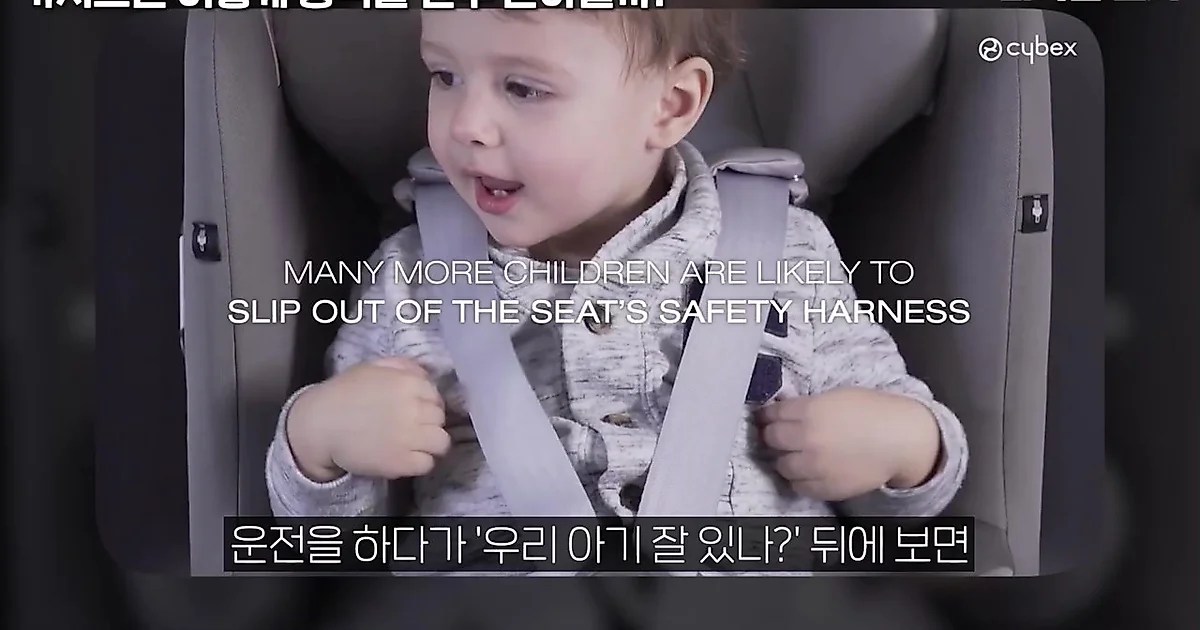
For families raising young children, a car seat is a necessity, not an option. However, it may be unfamiliar how simply strapping a child into a seat becomes a science that saves lives. According to a recently released video from BODA, the history of car seats has evolved from parental convenience to absorbing the safety principles used by astronauts.
From 1933 'Monitoring' to 'Safety' resembling space technology
The history of car seats began with the first introduction by Berni Bear's in the United States in 1933. An interesting point is that the purpose of car seats at that time was not child safety, but 'parental convenience.' The products at the time were in a form that raised the seat height to strap the child in, making it easy for parents to check if the child was doing well through the rearview mirror. It was a method of raising the seat height so that parents could easily monitor the child.
True safety car seats emerged in 1962 through the British inventor Gene Ames. He was inspired by how astronauts press their bodies against the backrest to withstand the powerful acceleration that occurs during takeoff and landing. Through this, 'rear-facing car seats,' where one sits in the opposite direction of the car's movement, were developed. This aligns with the principle of maximizing contact between the crew's body and the seat to eliminate gaps, noting that the impact occurring when the Russian Soyuz rocket returns to Earth is at its greatest. The video points out that if there is a gap, the impact can concentrate on the body's contact points, causing major injuries, and explains that rear-facing is the key to reducing such risks.
Children's physical structure differs from adults, characteristics of 'Soft material'
In the video featuring experts such as physicists and astronomers, they emphasize that children's bodies are fundamentally different from adults. If an adult's body is defined as a hard 'Rigid body,' children are closer to a soft 'Soft material.'
Children consist of about 300 bones, with bones not yet fully fused, and the gaps between bones are wider compared to adults (about 200 bones). In terms of body type, the head has a high proportion, accounting for about 25% of the total body weight, and the center of gravity is concentrated upward. Additionally, while an adult's spine takes an S-shape optimized for supporting weight, a child's spine, which is in the process of developing, is characterized by a C-shape curve. Due to these physical characteristics, newborns cannot control their necks, which becomes a fatal risk factor in an accident. In particular, if the head is exposed outside the protector, it can become vulnerable to external impact, requiring meticulous protection.
Physics of reducing impact: Increase the area and increase the time
The principle of how a car seat absorbs impact during an accident is explained by the physics concepts of 'impulse' and 'pressure.' Impulse occurs when the velocity of an object changes, and the car seat plays a role in reducing the impact force delivered to the child by maximizing the time at the moment of collision. The video explains that the process of a car crumpling upon impact, or the styrofoam material inside the car seat, helps distribute the impulse by buying collision time.
There are two main reasons why rear-facing car seats are safe. First, they increase the area of contact between the child's body and the car seat to distribute 'pressure (force/area).' Second, they lower the impact force by increasing the time it takes to come to a stop through soft materials. Experts appearing in the video explain, "If the area is wide, the pressure becomes smaller, so less impact is transmitted." This is consistent with physical strategies such as bending the hips to increase the area when receiving a punishment from a teacher, or moving the body in accordance with the opponent's movement to reduce relative velocity.
Furthermore, in the case of infants, the risk of 'Positioning asphyxia' caused by the inability to control the neck cannot be overlooked. According to statistics from the American Academy of Pediatrics and the National Highway Traffic Safety Administration, approximately 43–48% of infant traumatic deaths occurring during car seat use were due to airway obstruction. This is because general vehicle seats are designed based on adults and are slightly tilted; if rear-facing is performed in this state, the child's head can tilt forward due to gravity and block the airway. Therefore, the key to safety is a stable backrest angle design that considers the child's spinal curve and a deep head protector design that prevents head wobbling. In particular, standards such as the AGR certification serve as important indicators to determine whether an angle provides a fit that does not strain the child's spine and waist.
※ This article was written based on a video from the 'BODA' YouTube channel. For specific details regarding car seat selection and infant safety management, please be sure to consult an expert or check the guidelines of the product manufacturer.

하비이슈에서 건강·과학 분야를 주로 취재합니다. 테크·미래, 사회·이슈 기사도 함께 씁니다.



Comments 0