"What if I have to take a detour for 5 minutes longer?" The reason holiday congestion won't disappear even with autonomous vehicles
The video explains why traffic jams occur due to "phantom jams" and how even a single autonomous vehicle can mitigate congestion.
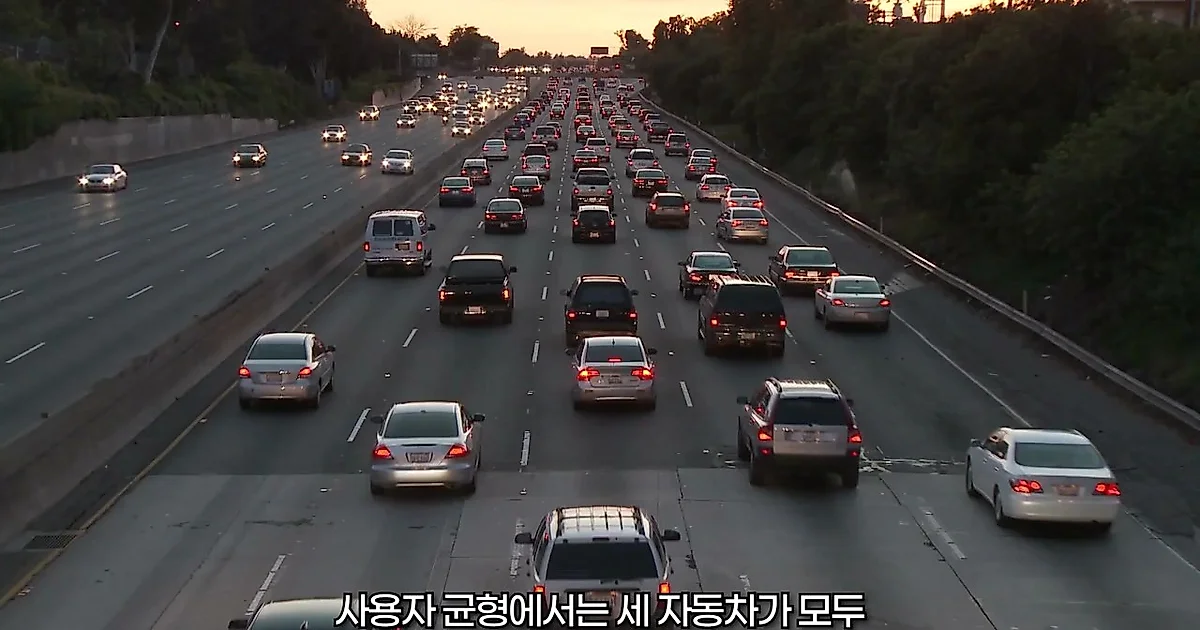
When driving on a highway during a holiday, one often witnesses the phenomenon where cars line up and stop even when there are no accidents or construction zones. According to a video by 'Unrealscience', this phenomenon is called a 'phantom jam'. This is because when a leading car slows down even slightly, the driver of the following car perceives this and hits the brakes, causing a delay in reaction time, which leads to an increasing magnitude of deceleration toward the rear, eventually forming a 'congestion wave' where cars come to a complete stop. This congestion wave, which moves in the opposite direction of the driving vehicles, is characterized by the flow of vehicles stopping and then restarting spreading toward the rear of the road.
Even a single autonomous vehicle can reduce congestion
It is not necessary for all vehicles to be replaced by autonomous vehicles to solve congestion. Citing an experiment by a United States research team in 2018, the video introduces the fact that even if just one automatically controlled vehicle is mixed among about 20 vehicles, the recurring congestion waves are significantly reduced. An automatically controlled vehicle does not react emotionally to the speed changes of the car in front, but instead drives smoothly by estimating the average speed of the road flow recorded over a certain period of time.
For example, when the speed of the leading car fluctuates between 10 and 30 km/h, instead of following it exactly, the automatically controlled vehicle drives steadily around the median value of 20 km/h. In this process, the empty space created between vehicles acts as a kind of 'shock absorber', reducing the magnitude of the speed change that starts from the leading car when it is transmitted to the following car. This experiment was conducted on a circular track, and it showed the effect of congestion decreasing slightly every time the congestion wave traveled around the track and repeatedly encountered the automatically controlled vehicle.
In a real road experiment conducted in Tennessee, United States, in November 2022, it was observed that 100 vehicles applying a special algorithm mitigated the changes in speed and acceleration of surrounding vehicles. As a result of tracking vehicle movements with hundreds of cameras installed over a section exceeding 6 km, it showed the possibility that automatically controlled vehicles could go beyond merely maintaining their own speed and even make the movements of surrounding cars smoother.
The dilemma between 'User Equilibrium' and 'System Optimization'
Autonomous driving technology can move beyond simply adjusting speed to the stage of 'connected autonomous driving', where the order of merging sections is decided or paths are designed together through vehicle-to-vehicle communication. While currently commercialized autonomous driving systems mainly perceive surrounding situations with cameras or radar sensors, if the 'connected' method, where vehicles exchange position and speed information, is introduced, it will be possible to decide in advance which car will enter first before arriving at a merging point. For example, coordination is possible where an entering vehicle goes behind the first lane vehicle, and the main line vehicle slows down to make space. In merging sections, where most commuting congestion occurs, this method can make the traffic flow even smoother.
The interesting point here is the philosophy of path selection. Current navigation follows 'user equilibrium', guiding individual drivers to the fastest route, but autonomous driving systems can aim for 'system optimization', which minimizes the total travel time for the entire road. In a state of user equilibrium, congestion can occur as all vehicles flock to the path judged to be the fastest. On the other hand, from a system optimization perspective, even if a specific vehicle (C) is guided to a national highway that involves a bit more detour, the choice is made to reduce the total time consumed by all vehicles on the road. When there are three vehicles A, B, and C, the method reduces the sum of total travel time by allocating A to the highway, B to the second fastest route, and C to the national highway.
The video poses the question, "If your travel time is reduced by 20 minutes but you alone have to take a detour for 5 minutes longer, would you follow the AI's guidance?", suggesting that a social consensus is needed on how to distribute the individual burden for the sake of total traffic. To bridge the gap between the interests of individual drivers and the efficiency of the entire system, the problem of how to distribute and compensate for the burden of someone taking a longer detour must also be solved together.
The possibility of a 'lane-less road' learned from the flow of ants
Future roads may depart from the method of driving along fixed lanes. Europe's 'Traffic Fluid' project is researching a method where vehicles flexibly use the entire width of the road by exchanging real-time position and speed information. This can take hints from ants in nature. According to an Argentina ant experiment in 2019, even when the density became high enough to fill 80% of the road area, ants maintained the flow by adjusting their speed. While humans or cars begin to see a decrease in throughput when about 40% of the road area is filled, ants adjusted the flow by increasing their speed as density increased, and only when it became very crowded, they lowered their speed and naturally reduced the number of newly entering ants.
Autonomous vehicles can also maximize the processing capacity of the road as individual vehicles move like one giant traffic system. When vehicles exchange position, speed, and path information and coordinate their movements with each other, they operate like one giant system. However, the video specifies that even if all cars become autonomous vehicles, congestion will not disappear completely. This is because there is a limit to the number of vehicles a road can physically pass through, and physical constraints such as accidents, construction, or narrowing of the road like entrance ramps or toll booths still remain.
Ultimately, future transportation will be able to show a different appearance from now only when, beyond the intelligence of individual vehicles, numerous vehicles are connected as one system and move together. Although the principles of ants and autonomous vehicles are not exactly the same, they are very similar in that they read the surrounding flow and change their movements to increase the efficiency of the whole.


Comments 0