KSTAR, which maintained 100 million degree plasma for 48 seconds, reveals core technologies for realizing the 'Artificial Sun'
South Korea is advancing nuclear fusion technology through KSTAR, aiming to harness the energy principles of the sun to meet surging global power demands.
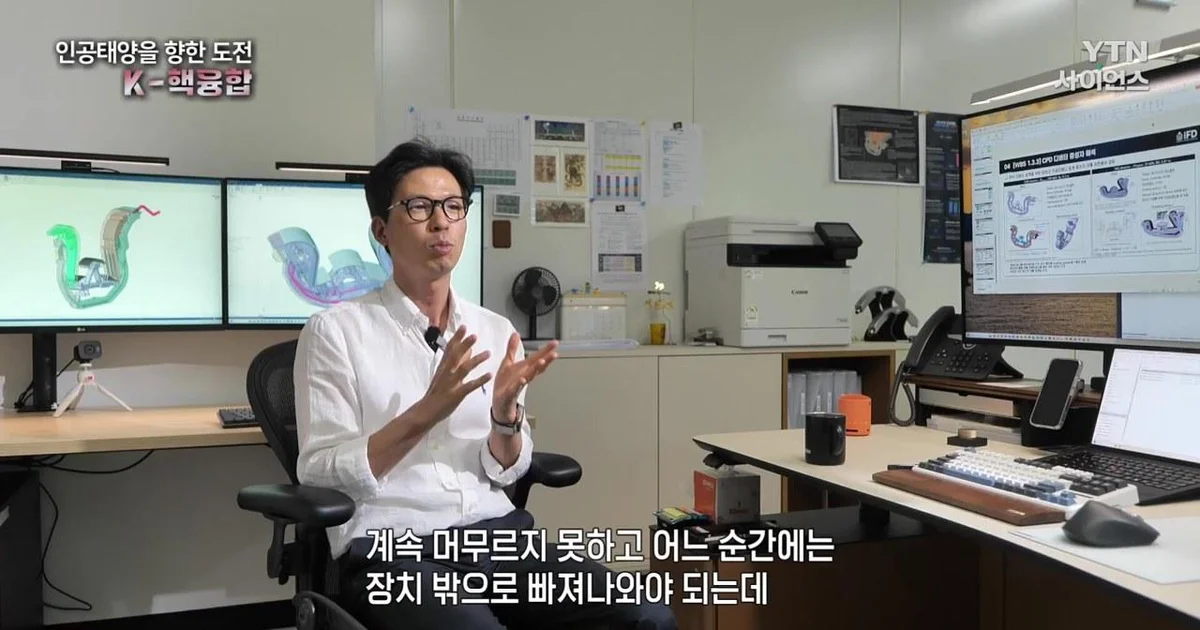
With the emergence of artificial intelligence (AI) and the expansion of robotic processes, power demand is surging far beyond past expectations. This is why nuclear fusion technology is drawing attention as a 'dream energy' that can produce massive amounts of energy without carbon emissions. According to the YTN Science documentary 'K-Fusion', nuclear fusion is a technology that generates electricity using the mass defect energy produced when light nuclei, such as hydrogen, fuse. To implement the principle of how the sun generates energy on Earth, South Korea is taking on the challenge through KSTAR, a Korean-style nuclear fusion research device.
How to confine and maintain ultra-high temperature plasma of 100 million degrees
To trigger nuclear fusion, an ultra-high temperature plasma state of over 100 million degrees is required. Plasma refers to a state where atomic nuclei and electrons are separated. While the sun holds these hot particles together with powerful gravity, on Earth, a 'Tokamak' device using magnetic fields is used. This method involves forming a donut-shaped magnetic field to confine the plasma in a spiral so that it cannot escape.
KSTAR is a superconducting fusion device that began development in 1995 and was completed in 2007 using independent technology. The researchers appearing in the video explain, "Rather than simply increasing the temperature with a heating device, the key is to use a magnetic field structure to hold the energy that has been put in so that it does not escape outward." In fact, the Korea Institute of Fusion Energy has set a world record for the longest operation by maintaining ultra-high temperature plasma of 100 million degrees for 48 seconds. In this process, advanced cooling technology that cools the device down to -269 degrees Celsius is essential for the superconducting magnets to perform at their best.
The 'Shield' that withstands heat loads equivalent to spacecraft launches: Divertor and Tungsten
Processing the extreme heat generated during the process of confining 100 million degrees of energy is one of the greatest challenges in realizing nuclear fusion. The key device to solve this is the 'Divertor'. As its name implies, the divertor plays the role of 'diverting' plasma particles and heat to a specific area to protect the interior of the device. According to the video, as future fusion devices will become smaller in size while increasing in output, the heat load the divertor must withstand is expected to increase further.
Based on current ITER standards, the heat applied to the divertor is at a level of 10MW/m², which is comparable to the peak heat flux during a spacecraft launch. In the future, this figure is expected to rise to 15–20MW/m². To withstand such extreme environments, researchers utilize 'tungsten', the metal with the highest melting point on Earth. Tungsten is a material that can withstand high temperatures of approximately 3,400 degrees Celsius or more. Korean researchers completed the divertor module by installing cooling pipes inside tungsten blocks and using technology to bond them firmly without welding. Currently, KSTAR is conducting preemptive research to replace its entire inner wall with tungsten material in preparation for future power plant models.
Tungsten, a core resource of South Korea, connects the future of nuclear fusion
Tungsten is a core material used not only in nuclear fusion but also in the semiconductor, aviation, and space sectors. In South Korea, where resources are not abundant, tungsten is one of the few resources with global competitiveness. The video also covers the process of mining tungsten ore in detail. After going through the 'concentration' process of picking out tungsten from rocks collected through drill cores deep underground, 'concentrate' with higher content is made, which is then processed into industrial forms through chemical smelting.
Currently, 34 countries, including South Korea, are accelerating technical verification by constructing ITER, the world's largest nuclear fusion project, in France. The acquisition of the '8 major nuclear fusion technologies', including superconducting magnet technology that stably confines plasma, is expected to be the key to future energy hegemony.

하비이슈에서 건강·과학 분야를 주로 취재합니다. 테크·미래, 사회·이슈 기사도 함께 씁니다.



Comments 0