"Is there anyone as rich as me?" A monk in a barren mountain hermitage becomes a 'protector' of birds
A KBS documentary follows the life of Monk Unsan, who lives in a remote, barren area of Wangmosan…
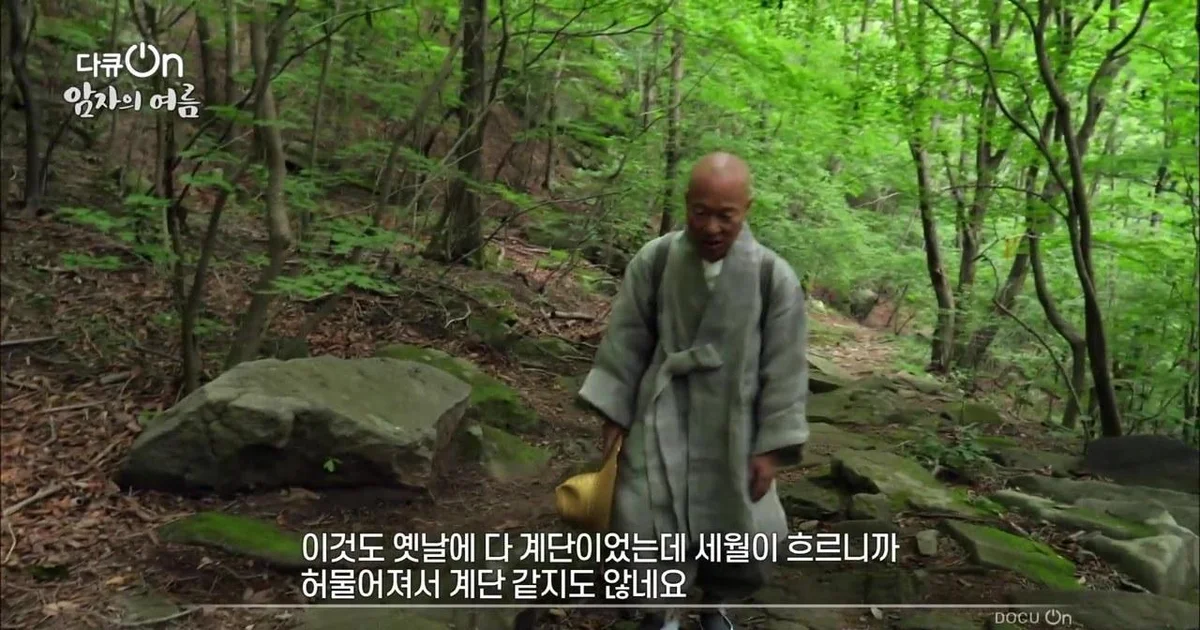
In a world where everyone is running forward, sometimes a 'pause' is necessary. According to a KBS documentary video, Monk Unsan's residence is located deep in the middle of Wangmosan, in a barren land that is difficult for human footsteps to reach. Like his name Unsan (雲梅山), which means 'Cloud Plum Mountain,' the monk stays here dreaming of a boundless life in nature where clouds flow in the river and the moon rises.
"I must live here even if I die" A foundation of life built on barren land
The place where the monk stays is a remote area where even water was difficult to obtain in the past, requiring him to draw water from a valley 600m away. It was only seven years ago that electricity was brought in, and the house was merely a thatched hut with only a foundation remaining. The monk says, "I built the house myself, working ten hours a day for a month and a half." Having guarded this place for 10 years, the monk expresses his affection for mountain life, saying, "Let's die here."
The monk's table is filled with what is obtained from nature. It mainly consists of crops he has cultivated himself, such as butterbur, cucumber flowers, chili peppers, pumpkins, melons, watermelons, lancewood, perilla seeds, and panilguji. Although the butterbur field did not do well again this year due to weed troubles, the monk says he also "adds a spoon" to the farming provided by nature, peeling and roasting them or putting them in soybean paste stew. The 14–15-year-old wild soybean paste has extremely high salinity as moisture continues to evaporate; the monk uses his own know-how to make the soybean paste, which is "so high in salinity that only salt crystals remain as moisture continues to evaporate," soft.
Having decided to leave secular life at the age of thirty-two after reading the writings of Beopjeong, the monk conveys the difficulties of ascetic practice, saying, "The days when I was thirsty even while in water, and when I bloomed flowers but failed to bear fruit, were times of great suffering." The story of a 'Wild Bird Protector' protecting birds from pythonsThere is one more special mission in the monk's daily life. It is the 'birdcages' he began making three years ago. These birdcages, which have now reached about 50, were made by the monk himself. There was a heartbreaking incident that led the monk to take the side of the birdcages. Recalling the day a python climbed up a tree and ate all the eggs in a birdcage, watching the mother bird wail for several days, the monk reminisces, "My heart aches." While both the python and the wild birds are precious lives, the monk decided to take the 'side of the wild birds' for their survival.
To prevent pythons from approaching the birdcages, the monk hangs them in the air and frequently checks on them so that the chicks can safely leave the nest. Recently, seven great tit chicks that hatched fifteen days ago have been receiving the monk's care. The monk feels anxious while installing protective barriers around the birdcages so that the fuzzy chicks can successfully become independent. The monk's heart for life is felt in his words, "If I don't do this, my heart is not at ease." Having seen a varied tit leave last year and a red-flanked bluetail leave this year, the monk is volunteering as a protector who looks after even the small affairs of wild birds.
"Every morning, the birds' songs are an orchestra" A small-scale rich man in the mountains
Various birds, such as red-flanked bluetails, great tits, and varied tits, visit the monk's hermitage like guests. The monk calls them 'guests' and describes the sounds they make as "an orchestra that makes me happy every morning."
People in the world might think that mountain life is isolation, but the monk says he is a rich man. The monk's question, "Is there anyone as rich as me?" signifies satisfaction coming from the sounds and scenery provided by nature and the communion shared with living things, rather than material abundance. The monk says, "My body is in hardship, but my heart is rich," and enjoys this small happiness that no one covets.

Comments 0