A 40-year veteran's fishing hook has no bait: The 'bullseye' hunting method of the autumn tidal flats
The EBS program 'Journey Through Korea - Autumn Hunters Part 3: Masters of the Tidal Flats' follows experts catching mudskippers and long-arm octopus…
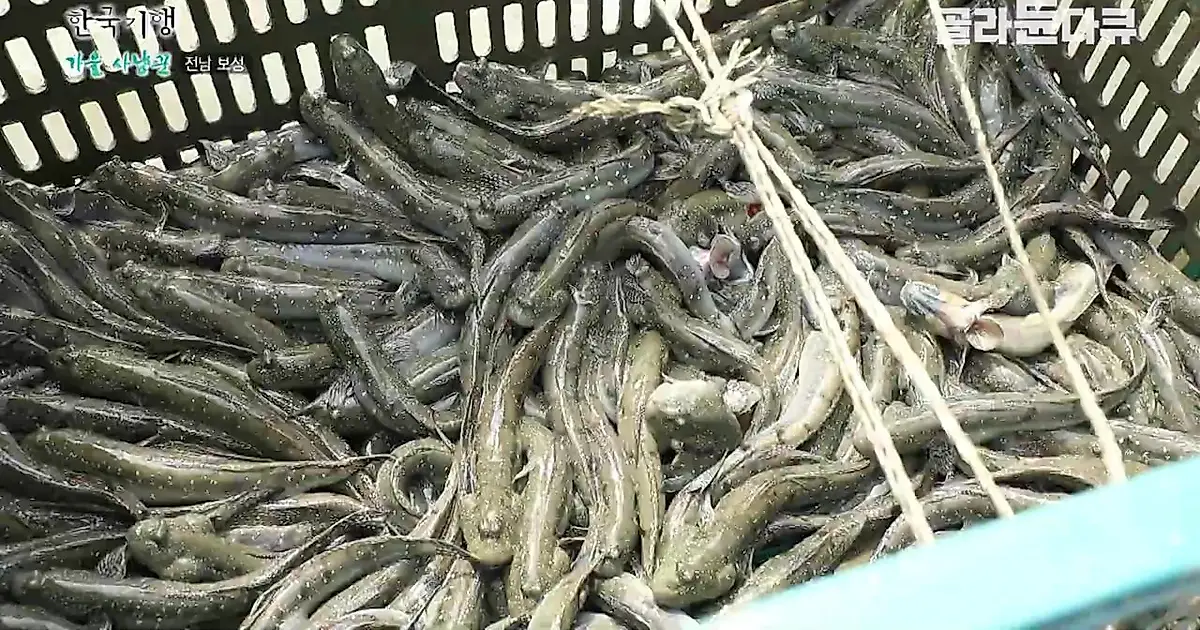
When the seawater recedes and the tidal flats begin to reveal their faces, there are people who invariably appear. The EBS 'Journey Through Korea - Autumn Hunters Part 3: Masters of the Tidal Flats' broadcast on October 21, 2020, visited experts catching mudskippers and long-arm octopus in the tidal flats of Beolgyo-eup, Boseong County, and Muan County in Jeollanam-do during the chilly autumn.
Hulchigi fishing: Catching mudskippers with baitless hooks
In Beolgyo, while mudskippers can be caught with bare hands during the warm spring, the only way to encounter them in the chilly autumn tidal flats is through mudskipper fishing. Lee Hwa-seong, who has been fishing on the receding tidal flats for 40 years, visited the tidal flats on this day as well. The reason he can move even in the tidal flats where his feet sink deep is because he has a 'ppulbae' (mud sled). After maneuvering across the tidal flats by pushing the mud sled, he hurries to prepare his gear as soon as he settles in.
The hulchigi fishing he uses is a method of using a line with four hooks attached that spring up like a fountain. He throws the baitless hooks over the tidal flats to snag part of the mudskipper's body. It is called 'hulchigi' because it is explained that if they fall, they get hooked anywhere—whether it be the head, tail, or torso. The basket is soon filled with mudskippers caught with unerring accuracy by Hwa-seong's hooks. This is a skill he learned by watching his father perform hulchigi fishing, a craft passed down through generations for 40 years. Since this time of year is when the mudskippers are at their peak fleshiness and flavor, he cannot easily leave the autumn tidal flats.
If Hwa-seong is the master of catching mudskippers, his wife Kim Jeong-sun is the master of preparing them. It is said that mudskippers, which do not open their mouths in the summer, open them when the chilly wind blows, and Jeong-sun quickly removes the entrails of the mudskippers whose mouths are wide open for the autumn. Mudskipper soup, boiled with young cabbage, is an autumn delicacy and health food that the couple enjoys during this chilly season. Thanks to his wife, who holds the mudskipper heads instead of the fleshy bodies for her husband, Hwa-seong remains unfazed even in the chilly autumn tidal flats.
Two scoops per second: Long-arm octopus hunting with a spade in Muan tidal flats
In Muan County, Jeollanam-do, there is Jeong Chae-jin, who heads to the tidal flats late in the day every day with a spade when the chilly autumn wind blows. He began catching long-arm octopus in middle school and has been digging for long-arm octopus for over 40 years this year. While others finish their work and come out as the water begins to rise, he instead heads deeper into the tidal flats. This is because the long-arm octopus, lacking oxygen in the tidal flats, rises up once the water begins to come in. This is his own 40-year know-how to easily dig for long-arm octopus. He said he can tell when the long-arm octopus will rise by watching the movement of the water.
The tool most frequently held in his hand is a spade called a 'garae'. Unlike regular spades, it costs 100,000 won, and it is said that the long-arm octopus is not easily injured when struck. Chae-jin says he earned back the cost of the expensive spade long ago. To catch the long-arm octopus, which reacts sensitively to even small vibrations, the key is to maintain a speed and strength of two scoops per second. When digging for the Muan three-legged long-arm octopus, which has thin and long legs, controlling strength is key: one must strike intensely like a bee and pick it up softly like a butterfly. This is why he, who is nearing sixty, is known as the best long-arm octopus catcher in the village.
Watching him makes it look easy, but when the production team tried it themselves, let alone catching long-arm octopus, it wasn't even easy to take a single step through the mud. The harvest Chae-jin made in about two hours filled the basket. While it is not without hardship, he heads to the tidal flats again today to preserve the tradition of long-arm octopus hunting with a 'garae' spade, a tradition that now only two people in the village maintain.
An autumn long-arm octopus feast prepared by the 'long-arm octopus ghost' wife
The reason Chae-jin catches long-arm octopus like this is because his wife Choi Yeong-ja is a 'long-arm octopus ghost' who loves them. It is said that whenever she feels like it, Yeong-ja picks a live long-arm octopus directly out of the basin where they have been caught and eats it. Long-arm octopus is in season from this chilly time until December, and among them, the three-legged long-arm octopus from the tidal flats is highly valued, costing 5,000 won per piece. Chae-jin said he earns the most money in September and October.
Yeong-ja rolled up her sleeves for her hardworking husband. A full table of autumn health foods was prepared: from long-arm octopus tangtangi drizzled with sesame oil and soy sauce, to refreshing yeonpotang containing live long-arm octopus, to sweet and sour cabbage long-arm octopus salad. The autumn three-legged long-arm octopus, famous for being sweet and tender, is perfect for tangtangi. It is excellent even without special seasoning, but if you drop a single drop of sesame oil into soy sauce, the long-arm octopus melts away in the mouth instantly. It is also a delicacy when lightly blanched and seasoned sweet and sour with acerola vinegar.

하비이슈에서 문화·라이프 분야를 주로 취재합니다. 사회·이슈, 건강·과학 기사도 함께 씁니다.

Comments 0