Italian Chef Surprised by the Expression "Doing One's Share of the Meal's Value" While Facing 3,000-Year-Old Carbonized Rice
Italian Chef Fabri visited the National Museum of Korea to explore the history and philosophy of Korean dining through the special exhibition…
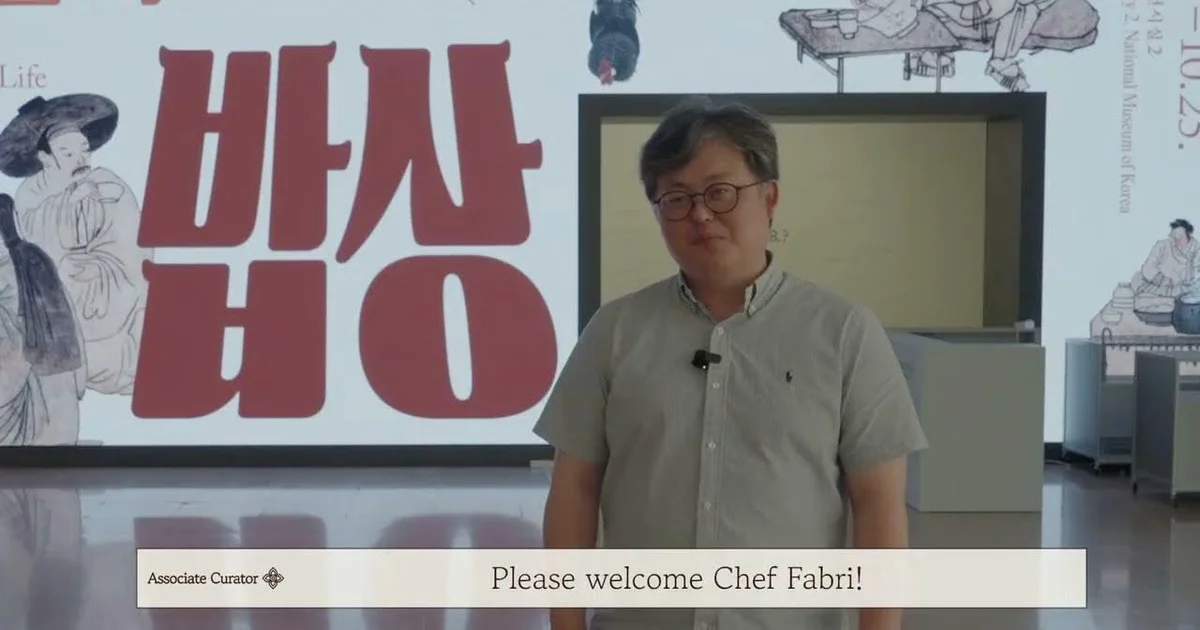
Italian Chef Fabri visited the National Museum of Korea with an affection for Korean food. His goal was to go beyond simply tasting food and to explore the history and philosophy of the dining table that is intertwined with the lives of Koreans. The National Museum of Korea recently held the special exhibition "Our Tables: Food, Nature, and Life," and a video was released showing Chef Fabri and curator Kim Min-cheol touring the exhibition together to examine the meaning of this exhibition.
The Korean Sentiment Contained in the Expression "Doing One's Share of the Meal's Value"
Upon entering the exhibition hall, the first thing Chef Fabri found interesting was a unique Korean expression. Throughout the exhibition hall, expressions related to meals that are frequently used in daily life, such as 'doing one's share of the meal's value' (bap-gap-eul hada) and 'not doing one's share of the meal's value' (bap-gap-eul mot-hada), were introduced. Chef Fabri expressed surprise, saying, "There are no such expressions in Italy." This highlights how the act of eating is an important symbol of life in Korea, to the extent that asking whether someone has eaten goes beyond a simple question and carries the meaning of a greeting.
The exhibition begins with traces from 3,000 years ago. Among the exhibited artifacts is 'carbonized rice,' which signals the beginning of an agricultural society approximately 3,000 years ago. This artifact shows that by making rice a staple food, agricultural communities and social cohesion referred to as 'we' were formed. The following folding screen depicting the farming process vividly portrays the series of steps from rice transplanting to harvesting, visually conveying the agriculture-centered life that became the foundation of Korean food culture.
Soup and Stew are 'Default,' the Number of Side Dishes Determines the Table Setting
An interesting explanation regarding 'cheop-su,' a characteristic of traditional Korean table settings, also followed. In table settings called five-cheop, seven-cheop, or nine-cheop bansang, soup and stew are not included in the count. According to the explanation in the video, soup and stew are considered the basic values of the table setting, or the 'Default.' The count begins to rise only when starting to count the actual number of side dishes.
Since traditional houses did not have the Western concept of a dining room, the role of the 'soban' (small dining table) for moving food was very important. The exhibited soban displayed their own unique personalities. From the 'gaedari-soban,' named because its legs resemble puppy legs, to the 'hojok-ban,' which resembles tiger legs, they show the essence of wood culture that resembles the shapes of nature. Additionally, the importance of 'namul' (seasoned vegetables), the core of Korean food culture, was emphasized. As there are over 250 expressions in the Korean dictionary that include the word 'namul,' the proportion of vegetable dishes on the Korean table is overwhelming.
The Secret to Kimchi is 'Animal-Based Ingredients,' Traces of Sauce from 1,700 Years Ago
An in-depth exploration of fermented foods was also conducted. In particular, for kimchi, the method of adding animal-based salted seafood (jeotgal) to add flavor was introduced as a unique characteristic of Korean kimchi. The exhibited book adds academic value as it is known to be the oldest recorded material among those containing kimchi recipes with animal-based ingredients.
Artifacts showing the roots of sauce (jang) culture also caught the eye. Traces of 'mae-ju' (sauce), estimated to be from about 1,700 years ago, remain in a charred form, proving that Koreans have been making and using sauce since a very long time ago. This artifact, which shows the origin of soy sauce and doenjang (soybean paste), the core seasonings of Korean food, became an important key for the foreign chef to understand the depth of Korean food.
Chef Fabri shared his thoughts, saying, "I came to Korea because I wanted to learn Korean food more deeply, and through today's exhibition, I fell in love with Korean food even more." The National Museum of Korea's special exhibition "Our Tables: Food, Nature, and Life" will continue at the National Museum of Korea's Second Special Exhibition Room until October 25, 2026.

하비이슈에서 문화·라이프 분야를 주로 취재합니다. 사회·이슈, 건강·과학 기사도 함께 씁니다.


Comments 0