The Twist of 9,740 Mirrors in a Desert Canyon: The Identity of 'Maraya Concert Hall' in the Guinness World Records
The article explores the architectural wonder of Maraya Concert Hall in AlUla, which is covered in 9,740 mirror panels…
Between the red desert land and massive rock walls, there is a building that appears like a mirage. To avoid harming the surrounding landscape, the entire building is wrapped in mirrors, consisting of a whopping 9,740 mirror panels. This is 'Maraya Concert Hall', which has been listed in the Guinness World Records as the largest mirrored building in the world. This creative structure, unfolding against the backdrop of a desert canyon, projects the surrounding scenery exactly as it is, creating the illusion of being one with nature. Tourists in the video visit this place to post photos on Instagram, and they all agree that they feel happiness and excitement due to its massive scale and beauty.
Jeddah, the Jewel of the Red Sea, Walking Through the Time of Hejazi Style
The journey begins in Jeddah, a port city on the coast of the Red Sea. This is the gateway to Mecca, the largest Islamic holy site, and a center of trade where millions of Muslims pass through every year for pilgrimage. The water of the Red Sea has a transparent emerald hue, which originates from the fact that red coral reefs under the sea reach the end of their life cycle, making the sea appear red. The coastal roads of Jeddah are well-developed with walking paths, making them a popular spot for many, and on the coast, a mosque that creates a mysterious atmosphere as if floating on water catches the eye. In Islam, prayers are offered a total of five times a day, and the tall minarets of the mosque serve to announce the prayer time so that even people far away can hear it.
Entering the 'Historic Jeddah, the Gate to Makkah', the old town of Jeddah, a landscape preserving hundreds of years of time unfolds. After passing through the 'Makkah Gate', which is part of the walls that once protected the town, traditional Hejazi-style houses featuring wooden balconies appear. It is said that in the past, the darker and more brownish the color of a house was, the taller the building and the residence of the wealthy. In particular, these houses feature cool two-story ceilings and well-ventilated windows, containing the wisdom of protecting privacy by being designed so that the interior cannot be seen from the outside. Inside one house, a photo of the grandfather of the person who first introduced bananas to Saudi Arabia and lived there in the 70s is hanging, proving the history of Jeddah.
The 'Al-Ma'mar Mosque', the symbol of the town and the center of life, is the oldest mosque in Jeddah; when the sound announcing the prayer rings out, the townspeople stop what they are doing and gather here. Today, they offer prayers to God and express gratitude for the peace of their country and families.
The Breath of the Nabataeans from 2,000 Years Ago, the Rock Tombs of Hegra
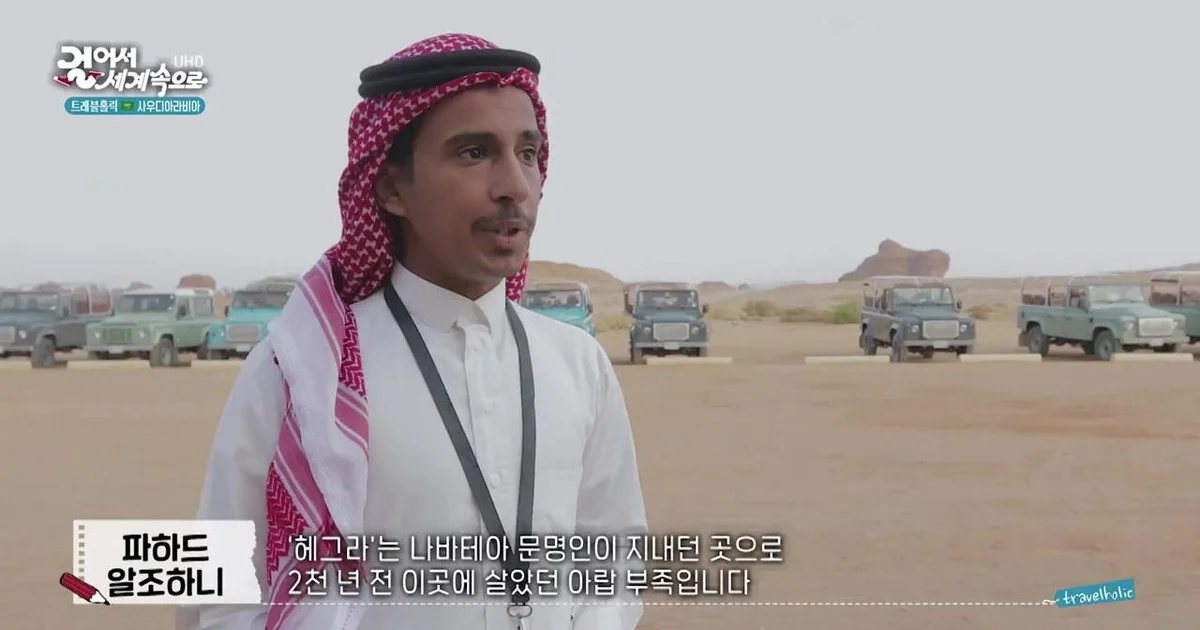
Arriving after a 1 hour and 30 minute flight from Jeddah is AlUla. Here lies 'Hegra', an ancient city where the Nabataeans, an Arabian tribe, resided 2,000 years ago. Listed as the first UNESCO World Heritage Site in Saudi Arabia, this is also a perfect spot for children's cultural explorations. Hegra is where the Nabataeans lived, and the traces left in the ruins are all tombs they carved into the rocks.
To enter the ruins, one must use only designated jeeps. There are a total of 111 tombs carved into the massive rocks. Upon arriving at the 'Jabal Al-Ahmar' area, one can see that the holes visible everywhere are the entrances leading to the tombs. Inside the tombs, the forms of that time are preserved as they were, and the names of the tomb owners are written at the entrances. In particular, as many as 18 tombs are carved into just one large rock, all of which were made in the 1st century BC. The most magnificent tomb, 'Qasr al-Farid', reaches the height of a 10-story building, and the top stairs symbolize the path to heaven. However, these massive rock tombs remain in an unfinished state, conveying both the mystery and the regret of an ancient civilization.
'Elephant Rock', one of the wondrous landscapes of AlUla, is a massive rock rising 50m above the golden sand desert. This rock, which was submerged in water about 8 to 9 feet deep in the past, looks like a sculpture crafted from water. When the sun sets, the area in front of Elephant Rock transforms into a massive cafe made of sand dunes, providing unforgettable memories to people.
Desert Oasis and Fragrant Hospitality
Another charm of AlUla is 'Daimoda', an oasis village that continues to sustain life even in the arid desert. This place grows date palm trees through an irrigation system that uses water stored underground, and unlike the past, they continue farming in the desert by developing water storage systems. When visiting the old town of AlUla, one can encounter 'Saudi coffee' offered by locals as a sign of welcome. This coffee, which tastes similar to ginger tea, is characterized by being enjoyed with sweet and savory date fruits. Inside the date fruits, there are almonds that add a sweet and savory taste.
Additionally, luxury perfumes containing the scent of the Middle East catch the eye in the shops here. In particular, 'Oud' perfumes containing the scent of wood emit a deep and thick forest scent, and some products are traded at high prices, reaching as much as 3,622 dollars (approximately 4.8 million won) for 12ml. Located at the edge of the desert, at the end of the 800km long Tuwaiq Desert, 'Edge of the World' shows wondrous cliffs formed by earthquakes. The iron-wall-like cliffs continuing 300m down are called the Grand Canyon of the Middle East, adding depth to the journey.



Comments 0